
For the last few years, most of the AI people use has lived on a screen. You type a question, a model writes an answer. If the answer is wrong, you get a bad paragraph. Physical AI is the next step: AI that sees, decides and moves in the real world, where a wrong answer means a robot falls over.
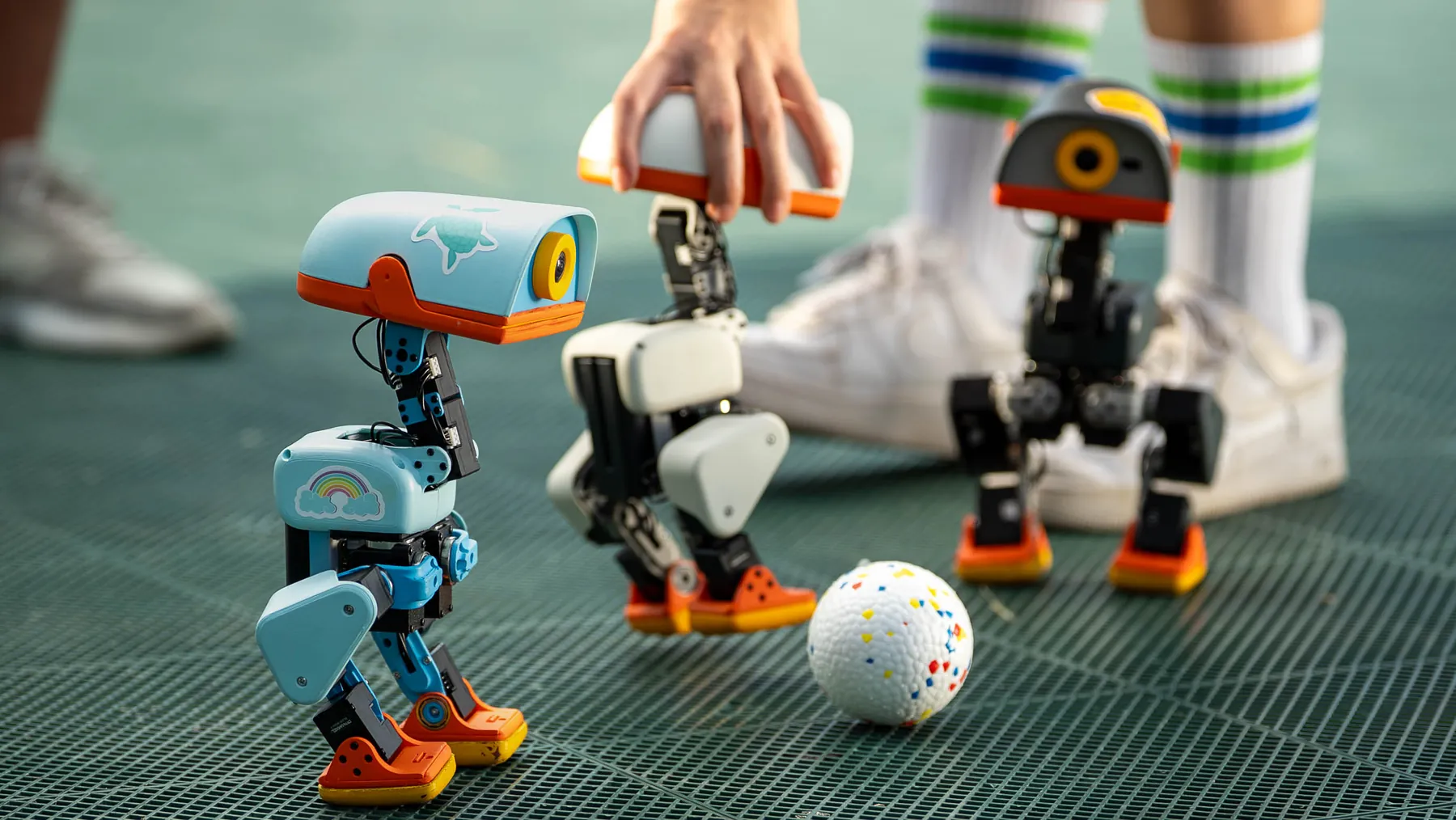
On October 21, 2026, at GTC Berlin, NVIDIA CEO Jensen Huang said that “the ChatGPT moment for robotics is coming fast,” according to NVIDIA's announcement. On the same stage, four small duck shaped robots called Microduck walked out, tumbled, got back up and showed, in a very public way, both the promise and the difficulty of physical AI.
This guide explains what physical AI is, how it differs from chatbots, why it is so hard, what Microduck is, and how that robot learns to walk step by step, so the whole idea becomes concrete.
What Is Physical AI?
Physical AI is artificial intelligence that perceives the physical world through sensors and acts on it through a body: a robot, a vehicle, a drone or a machine. Instead of producing text or images, it produces actions, such as motor commands, steering or grasping.
It combines several kinds of AI that already exist: perception (understanding camera and sensor data), decision making (choosing what to do next) and control (turning decisions into precise movements many times per second). What makes it physical is that every output has a consequence in the real world.
How Physical AI Differs From Chatbots
A useful way to understand physical AI is to compare it with the generative AI behind chatbots:
- Input: a chatbot reads text. A robot reads cameras, motion sensors, distance sensors and the position of every joint, continuously.
- Output: a chatbot writes tokens. A robot sends commands to motors, often 50 times per second or more.
- Training data: a large language model learns from vast amounts of text on the internet. There is no internet sized dataset of robots moving, so robots must learn largely in simulation.
- Mistakes: a chatbot's mistake is a wrong sentence, often called a hallucination. A robot's mistake is a fall, a collision or a broken part.
- Time pressure: a chatbot can take a few seconds to answer. A walking robot that pauses to think falls over.
Why Physical AI Is So Hard
- Data is scarce and expensive: every real world trial takes time, wears out hardware and can break things.
- The sim-to-real gap: a policy that works perfectly in simulation can fail on a real robot, because real motors have friction, delay, worn gears and slightly different weights.
- Real time limits: the robot's own computer must run the controller fast, often on cheap, low power hardware.
- Safety: unlike a chatbot, a robot can hurt people or property, so testing must be careful.
Most modern physical AI work is about getting around these problems: training in simulation where data is free, and making simulation messy enough that the result survives contact with the real world.
What Is Microduck?
Microduck is a small two legged robot shaped like a duck, made by Pollen Robotics, the robotics company owned by Hugging Face. It opened for pre-order on August 27, 2026 at 399 dollars, according to TechCrunch, with first deliveries targeted before Christmas 2026 in North America and Europe.
According to CNX Software, it stands about 25 cm tall, weighs under 800 g and has:
- 15 motors in its legs, head and neck, plus a beak that can grip small objects. It has no arms.
- A front camera, two motion sensors (IMUs), an 8x8 depth sensor, a microphone and a speaker.
- A Rockchip RK3566 processor with 1 GB of RAM and 32 GB of storage, plus Wi-Fi, Bluetooth and NFC.
- A battery that lasts about one hour.
- Seven pre-trained behaviors out of the box, controlled with the included gamepad: walking, sitting and standing, kicking a ball, grabbing objects, roller skating with a wheel kit and getting back up after a fall.
Its software is open source under the Apache-2.0 license, including the code on the robot and the training tools, according to Pollen's GitHub repository. The hardware is not: the 3D model files are licensed for non-commercial use only. Microduck does not chat or answer questions. It is built for one purpose: making it cheap to experiment with teaching a real robot new skills.
How Microduck Learns to Walk: Physical AI Step by Step
Microduck is a clear example of the modern physical AI workflow. Nobody writes code that says “move the left leg 20 degrees”. Instead, the robot learns by trial and error in a virtual world, then that learned behavior is copied onto the real robot.
Step 1: Build a digital copy of the robot
The robot is modeled in a physics simulator, with its shape, weight and joints, and a model of how its Dynamixel XL330 motors actually respond. Pollen's own training tools, microduck_rl, use the MuJoCo based simulator mjlab.
Step 2: Practice thousands of times in parallel
Learning to walk uses reinforcement learning: the virtual robot tries actions, gets a reward when it moves in the requested direction without falling, and slowly improves. Because simulation runs on a GPU, thousands of virtual ducks can practice at once. Pollen's documentation says a usable walking gait takes about 1 to 2 hours with 4,096 simulated robots running in parallel.
Step 3: Make the simulation messy on purpose
To close the sim-to-real gap, the training randomizes things the real world will vary: battery voltage, delays, friction, and even about one degree of play in the gears. This technique, called domain randomization, forces the policy to work across many slightly different robots, so it is more likely to work on the real one.
Step 4: Export a small brain
The result is a compact neural network, called a policy, exported in the standard ONNX format. For Microduck, it takes 61 numbers describing the robot's state (joint positions, motion sensor readings, the requested direction and more) and outputs 14 joint commands.
Step 5: Run it on the robot
On the robot, software written in Rust runs that policy 50 times per second on the inexpensive Rockchip processor. The heavy work, training, happened elsewhere on a GPU; the robot only needs to run the finished policy.
This split is the core idea of physical AI today: expensive learning in simulation, cheap execution on the device.
Where NVIDIA Fits In
Microduck's onboard chip is not from NVIDIA, but its training is closely tied to NVIDIA's tools. Local training needs an NVIDIA GPU, or it can run on Hugging Face's cloud jobs. On October 21, 2026, NVIDIA and Pollen also published a second training path using NVIDIA Isaac Lab 3.0 and the Newton physics engine, and Jensen Huang showed four Microducks on stage at GTC Berlin.
This matches the way NVIDIA describes physical AI: one computer to train the model, one to simulate the world, and one on the robot to run it. Microduck makes that three step pipeline small and affordable enough for students and hobbyists to try.
Chatbot vs Robot: The Same Ideas, Different Body
Many ideas transfer directly from the AI tools you may already use:
- Pretraining on text becomes training in simulation.
- A prompt becomes a stream of sensor readings.
- Generated words become motor commands.
- Fine-tuning becomes training a new skill, such as kicking or roller skating.
- Sharing a model on Hugging Face becomes sharing a robot behavior. Pollen's stated plan is to let people share Microduck behaviors the way they share models today.
Concepts like AI agents and orchestration also carry over: future robots are likely to combine a language model that plans with fast control policies like Microduck's that execute.
Where Physical AI Is Being Used
- Warehouses and logistics: robots that pick, move and sort goods.
- Manufacturing: robot arms that adapt to new parts without being reprogrammed by hand.
- Autonomous vehicles and drones: perception and control in changing environments.
- Humanoid robots: general purpose robots such as the Agile ONE SN reference humanoid NVIDIA announced for early 2027, and the Unitree R1.
- Education and research: low cost platforms like Microduck that let students practice the full sim-to-real workflow.
How to Try Physical AI With Microduck
You do not need to own the robot to start, since most of the workflow happens in simulation:
- No code: open the browser simulator on Hugging Face (Space pollen-robotics/microduck-simulator) and drive the virtual duck. Chrome works best.
- Pollen's path: clone microduck_rl and train a walking policy on a computer with an NVIDIA GPU, or on Hugging Face Jobs.
- NVIDIA's path: follow the Isaac Lab 3.0 Microduck tutorial on a Linux machine with an NVIDIA GPU.
- Buying the robot: order through pollen-robotics.com. The first batch sold out and new orders are expected to ship after Christmas 2026.
Limits to Keep in Mind
- Microduck is a learning platform, not a working robot: about one hour of battery, 1 GB of RAM and a small beak.
- No units had shipped as of late October 2026, so how well simulated skills transfer to thousands of real robots is still unproven.
- Even the public demo at GTC Berlin was wobbly: when told to nap, three of the four robots tipped over, as Interesting Engineering reported.
That last point is the most honest summary of physical AI in 2026: real progress, real excitement, and a lot left to solve.
What Physical AI Means for Businesses
For most businesses, physical AI is not about buying robots this year. It is about understanding where AI is heading: from tools that write and summarize, to systems that act. The skills that matter, such as defining clear goals, building good data, testing in safe environments before going live, and keeping people in the loop, are the same skills that make today's AI projects succeed.
If you want your team to understand and use AI with confidence, from chatbots and RAG to agents and what comes next, our AI training program can help. Contact us to plan a session.
Frequently asked questions
What is physical AI?
Physical AI is artificial intelligence that perceives the real world through sensors and acts on it through a body, such as a robot, vehicle or drone. Instead of text or images, it produces actions like motor commands.
How is physical AI different from generative AI?
Generative AI produces text, images or code from internet scale data. Physical AI produces actions in real time from sensor data, has little real world training data, and its mistakes have physical consequences, so it is usually trained in simulation first.
What is Microduck?
Microduck is a 399 dollar, 25 cm two legged duck shaped robot from Pollen Robotics, owned by Hugging Face. It has 15 motors, a camera and sensors, open source software, and is designed for learning how to train robot skills in simulation and run them on a real robot.
How does Microduck learn to walk?
It is trained with reinforcement learning in a physics simulator, with thousands of virtual robots practicing in parallel and randomized conditions to bridge the gap to reality. The resulting policy is exported as an ONNX file and runs on the robot 50 times per second.
What is the sim-to-real gap?
It is the difference between how a robot behaves in simulation and in the real world, caused by friction, delays, worn parts and other details simulators miss. Techniques like domain randomization help policies trained in simulation work on real robots.
Need help with this?
Growthtrait can help you put this into practice. Let's talk about your goals.
Contact us