
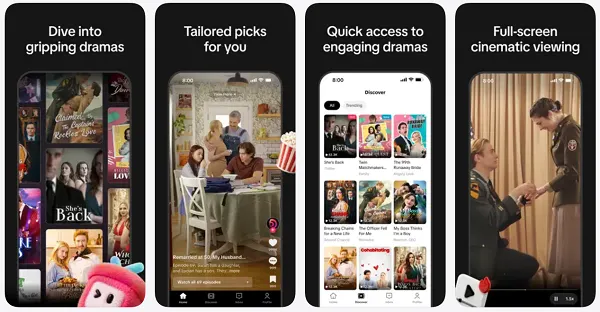
If you have scrolled TikTok or Facebook this year, you have almost certainly seen one: a vertical clip that opens on a slap, a secret pregnancy or a billionaire in disguise, builds for a minute, and cuts off right before the reveal. Tap, and you land in an app like ReelShort or DramaBox, where the next episode costs a few coins. These are short drama ads, and they have quietly become one of the most aggressive performance ad categories on social media.
The money behind them is real. Sensor Tower estimates short drama apps earned about US$750 million in in-app revenue in Q1 2026 alone, with more than 850 million downloads that quarter. Appfigures data reported by TechCrunch puts ReelShort at roughly $1.2 billion in gross consumer spending in 2025, up 119 percent in a year. Much of that growth is bought with ads.
This guide covers what short drama ads are, how big the market has become, why these apps spend so heavily on social, the creative formula behind a winning drama ad, how AI is changing production, the risks, and what brands in Vietnam and elsewhere can borrow from the format.
What Are Short Drama Ads?
Short dramas, also called micro dramas or vertical dramas, are scripted series shot for phones, with episodes of one to three minutes and storylines built on fast twists: revenge, hidden identities, forbidden romance, family betrayal. Apps release the first episodes free, then ask viewers to pay per episode with coins, watch an ad, or buy a subscription to keep going.
A short drama ad is usually cut straight from those episodes. It shows the most explosive scenes and stops at a cliffhanger, so the only way to find out what happens is to install the app. As TechCrunch describes the model, when a story seems to be heating up, you are prompted to pay tokens, watch an ad, or buy a VIP pass, in one example $20 a week. The ad and the paywall are designed around the same moment of tension.
How Big Is the Short Drama Market in 2026?
- Global apps: about US$750 million in in-app revenue in Q1 2026, up 20 percent year on year, with DramaBox and ReelShort each near US$140 million, according to Sensor Tower.
- Engagement: average daily time in short drama apps reached 25 minutes globally by April 2026, and close to 40 minutes a day in Southeast Asia.
- Downloads: Southeast Asia accounted for 32 percent of global short drama downloads in Q1 2026, ahead of Latin America and India.
- China: the domestic micro drama market exceeded 100 billion yuan (about US$14.9 billion) in 2025 with more than 800 million users, according to China's broadcasting regulator NRTA.
Revenue estimates vary widely depending on whether they count only app store purchases or also web payments and ad revenue, so treat any single headline figure as an estimate. The direction, though, is consistent across every source: fast growth, led by the United States in revenue and by Southeast Asia, Latin America and India in downloads.
Why Do Short Drama Apps Spend So Much on Ads?
Short drama apps are built like mobile games. Content is cheap relative to the cost of finding paying viewers, so user acquisition is the core of the business. Vietnam's Cong Thuong newspaper reported that ReelShort's user acquisition and marketing costs equalled 55 percent of its 2025 revenue.
Most of that money goes to social. Sensor Tower data compiled by eMarketer found that 68 percent of US ad spending by ReelShort, DramaBox, GoodShort, NetShort and ShortMax went to social networks between January and September 2025. Outside the US, the mix shifts toward ad networks: Insightrackr's April 2026 tracking shows one app running mostly on Meta Audience Network and AdMob, another on Pangle and Kwai, and a third almost entirely on Moloco, with daily active creatives peaking near 1,000 for a single app.
That last number is the key to the category. Short drama advertisers do not rely on one hero ad. They test hundreds of cuts, keep the few that win, and replace them as soon as they fatigue.
What Makes a Short Drama Ad Convert?
The creative formula is consistent across the category, even if exact performance data is mostly private. Ad tech vendor Mobvista, for example, recommends dropping the twist in the first three seconds and building a three act story in under three minutes. The common elements:
- Open on conflict, not context. The first three seconds show a confrontation, a betrayal or a shocking line, never a logo or a slow setup.
- Use instantly readable tropes. Revenge, hidden wealth, mistaken identity and romance need no explanation, which matters when viewers decide in seconds.
- Cut at the peak. The ad ends on an unanswered question, so the install is the answer.
- Look native, not polished. Clips that feel like content outperform clips that feel like brand campaigns.
- Localize. Sensor Tower credits localized creatives and market specific content as a growth driver, from dubbed versions to locally shot series.
- Test at volume. Many cuts of the same series, with different opening scenes, captions and lengths, let the algorithm find the winner.
In emerging markets, some apps add a second hook. Insightrackr found creatives in Indonesia and Brazil promoting watch to earn rewards, with e-wallet and banking imagery, a sign of how far the category will push for installs.
What Can Other Brands Learn From Drama Ads?
You do not need to run a drama app to use the format. Brands have started commissioning their own micro dramas, and Marketing Dive tracked several in 2026. Crocs built a ReelShort series around its Jibbitz charms as a central plot device, drawing nearly 10 million views and a sequel. JCPenney's five part micronovela with TelevisaUnivision reached over 16 million impressions and 5.6 million video views. P&G and General Mills have run their own series too.
The transferable lessons are simple: open your ads on tension instead of a logo, tell stories in episodes so viewers come back, make the product part of the plot rather than an interruption, and end on a question. The same experts are cautious, though. One warned there is almost too much content made for too few people, and another advised starting with shorter series and clear KPIs instead of a large, unproven bet.
How Is AI Changing Short Drama Production?
AI is turning short drama into a volume game. China's regulator reported that 430,000 micro dramas launched online in the first eight months of 2026, 13 times the previous year's total, and that AI generated titles accounted for more than 90 percent of them. The same regulator now requires AI dramas to be labelled and platforms to respect portrait and voice rights, and said 68,000 violating micro dramas were removed this year.
For advertisers, AI cuts the cost of testing new stories and ad variants, which favours teams that can produce and test quickly. It also means more competition for the same attention, and a growing need to disclose AI generated content clearly.
What Are the Risks of Short Drama Ads?
- Consumer trust: TechCrunch notes the model replicates the same dark patterns as mobile games. In Vietnam, weekly passes can reach 199,000 to 299,000 dong and renew automatically until cancelled, according to Cong Thuong.
- Age ratings: the same app can be rated 16+ on the App Store and 12+ on Google Play, and app ratings do not classify each film inside.
- Regulation: under Vietnam's Decree 87/2026, failing to classify films or display ratings can bring fines of 40 to 50 million dong for individuals and 80 to 100 million dong for organisations.
- Brand safety: sensational scenes that win clicks can clash with platform ad policies and with your brand's tone.
What Does This Mean for Marketers in Vietnam?
Vietnam is already a real short drama market. Adjust data reported by CafeBiz shows short drama apps earned US$11.5 million in in-app revenue in Vietnam in 2025, and downloads rose 271 percent year on year in Q4 2025. Yet none of the ten short drama apps surveyed on Vietnam's App Store by Cong Thuong was run by a Vietnamese company, which leaves room for local studios, creators and brands.
For most brands, the practical move is not to launch an app but to borrow the format. Start with a small test: a three episode story built around your product, cut into several ad variants that open on conflict, measured against your current best video ad on hook rate, hold rate, cost per acquisition and return visits. Keep claims honest, label AI generated content, and make sure anything you publish as a film follows Vietnam's classification rules.
If you want help turning this format into ads for your brand, our AI content and creative production service can script, produce and test episodic creatives with you. Contact us to plan a pilot.
Frequently asked questions
What are short drama ads?
Short drama ads are vertical video ads cut from micro drama series, usually showing the most dramatic scenes and ending on a cliffhanger so viewers install an app like ReelShort or DramaBox to see what happens next.
Why do short drama apps advertise so much?
Their business depends on acquiring viewers who pay per episode or subscribe. ReelShort's user acquisition and marketing costs equalled 55 percent of its 2025 revenue, and most US spend by leading apps goes to social networks.
How do you make a short drama ad?
Open on conflict in the first three seconds, use tropes viewers recognise instantly, keep the editing native rather than polished, end on an unanswered question, and test many variants of the same story to find winners.
Can non-entertainment brands use micro dramas?
Yes. Brands such as Crocs, JCPenney, P&G and General Mills have run branded micro dramas. Start with a short series, make the product part of the plot, and set clear KPIs before scaling.
Is the short drama market growing in Vietnam?
Yes. Short drama apps earned US$11.5 million in in-app revenue in Vietnam in 2025, and downloads grew 271 percent year on year in Q4 2025, according to Adjust data reported by CafeBiz.
Need help with this?
Growthtrait can help you put this into practice. Let's talk about your goals.
Contact us