
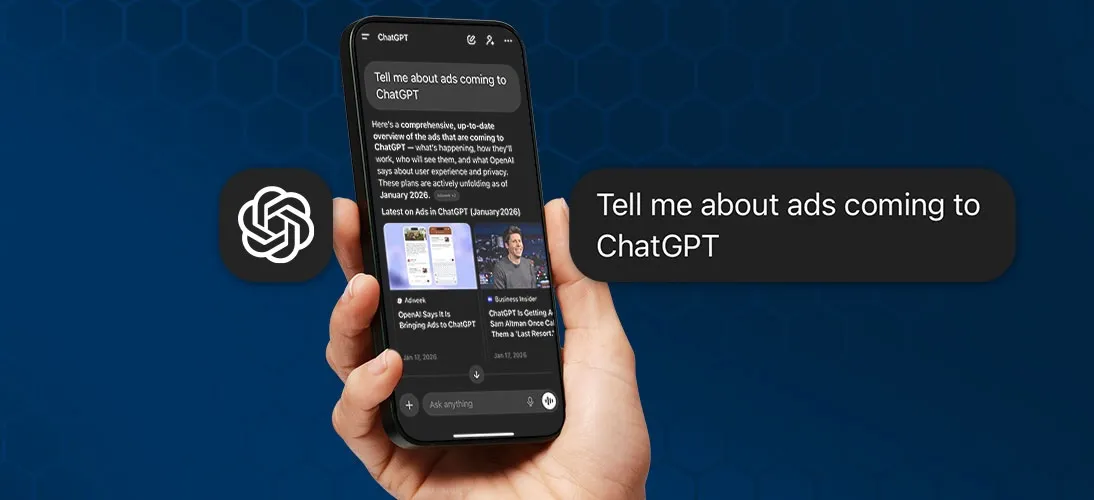
For most of ChatGPT's life, the only way OpenAI made money from it was subscriptions. That changed in early 2026, and by September, advertising inside ChatGPT had grown into a full platform with its own ad manager, its own measurement tools, and its own controversy. This month alone brought a new ad format that starts a conversation with a brand, a Shopify integration, and an expansion into seven new markets, including Vietnam.
The pace is the story here as much as any single feature. OpenAI's ad business reportedly reached a $1 billion annualized revenue run rate in under 200 days, and September 2026 was the busiest month yet for new features shipping on top of that growth.
This post covers what ChatGPT Ads actually is and how it works, what OpenAI changed in September, the expansion into Vietnam and Southeast Asia, the skepticism from advertisers and media agencies, and what it means for your brand whether or not you plan to buy a single ad.
What Is ChatGPT Ads?
ChatGPT Ads is OpenAI's advertising platform, letting businesses buy placements shown to ChatGPT users. OpenAI first announced plans to test ads on January 16, 2026, and began the pilot in the United States on February 9, 2026 with launch partners including Target, Adobe, Williams-Sonoma, and Albertsons. The pilot expanded to the United Kingdom, Mexico, Brazil, Japan, and South Korea by August 11, 2026, and has kept growing since.
From the start, OpenAI built the format around a few fixed rules: ads are shown only to people on the Free and Go plans, while Plus, Pro, Business, Enterprise, and Edu subscribers see no ads at all. Ads are clearly labeled and displayed separately from ChatGPT's own answers, they do not influence what ChatGPT says in response to a question, and advertisers do not get access to a user's private conversations.
How Does ChatGPT Ads Work?
Advertisers manage campaigns through OpenAI's Ads Manager, either self-service or through a media agency. OpenAI already works with major agency groups, including dentsu, Havas Media, Omnicom Media, Publicis Groupe, and WPP, alongside the self-service option aimed at smaller businesses. Ads appear alongside relevant conversations, and as of September, advertisers can also connect the platform to commerce and CRM tools rather than running it as a standalone system, which is the part that changed the most this month.
Sponsored Agents: The Biggest Change This Month
On September 16, 2026, OpenAI published Reimagining advertising with AI, introducing Sponsored Agents, its most significant new ad format since the original launch. After seeing a relevant ad, a user can choose to open a separate, clearly labeled conversation with a brand-sponsored agent, ask it product questions, and receive personalized recommendations and links back to the business, all without leaving ChatGPT.
OpenAI built the format around three guardrails: the agent conversation is explicitly marked as sponsored, it stays separate from ChatGPT's own independent answers, and it does not touch the user's original chat context. The feature is still experimental, limited to the United States with a small set of advertisers, and OpenAI has not announced an international timeline.
New AI Ad Tools and Integrations With HubSpot and Shopify
The same announcement introduced a set of AI tools for building and managing campaigns. Advertisers can now write natural-language prompts inside Ads Manager to create, update, and analyze campaigns, and a creative assistant suggests ad copy and images pulled from a business's own landing pages. Every suggestion still requires human review before it goes live, and an optional feature auto-translates ad text into each user's preferred language.
OpenAI also added its first CRM and commerce integrations. HubSpot became the first CRM partner, letting businesses connect their ChatGPT Ads account, create ads, and follow up on leads without leaving HubSpot. Shopify became the first commerce partner, and the ChatGPT Ads app for Shopify went live in the Shopify App Store on September 23, letting merchants connect their store, auto-sync their product catalog, and install the OpenAI Pixel for tracking, with international availability rolling out from that date.
Better Measurement: Conversion Optimization and Attribution Windows
Alongside the new formats, OpenAI made two measurement features generally available on September 16. Conversion optimization with impression billing now lets campaigns optimize for conversions driven by both ad clicks and ad views, while billing on an impression basis. Flexible attribution windows let advertisers choose a 7, 14, or 30 day click window and a 0 or 1 day view window for conversion reporting, giving campaigns more control over how credit gets assigned across a buying journey.
ChatGPT Ads Expands to Vietnam and Six Other Markets
On September 23 and 24, ChatGPT Ads expanded into seven new markets: Indonesia, Malaysia, the Philippines, Singapore, Thailand, Vietnam, and Taiwan, bringing the platform's total footprint to more than 60 countries. This follows earlier Asia Pacific launches in Australia, New Zealand, Japan, South Korea, and India. Eligible businesses in these new markets can set up campaigns directly through the self-service Ads Manager, in addition to going through one of OpenAI's agency partners.
For a Vietnamese or Southeast Asian brand, this is the part of the update that actually matters day to day. Until now, running an ad inside ChatGPT required going through a market where the platform was already live, which was not an option for most local businesses. As of this expansion, that barrier is gone in Vietnam.
Should Advertisers Be Wary?
Not everyone is convinced the format is ready. The Register was blunt about letting AI generate ad copy from a prompt, warning it risks producing low quality ads inside low quality answers, and questioned a design that keeps users inside ChatGPT rather than sending them to a business's own site. Performance Marketing World ran a piece asking whether advertisers should be wary of Sponsored Agents at all, and pivot-to-ai reported that media agencies came away underwhelmed by the September announcement.
There is a more structural concern underneath the format-specific criticism. Researchers and commentators have pointed to what some call the fake friend dilemma: a conversational agent's interests are not necessarily aligned with the user asking it questions, since the same agent is also working for the advertiser that sponsored it. OpenAI's labeling and separation rules are a direct response to that concern, but whether users reliably notice and act on the label in practice is still an open question, not a solved one.
What This Means for Your Brand
Even if you never buy a ChatGPT ad, the platform's growth is worth tracking. A billion dollar run rate in under 200 days and expansion to more than 60 countries means a meaningful share of your audience is already inside ChatGPT with some frequency, and increasingly, in a market where you can be found there. Whether that presence comes from a paid Sponsored Agent or from being the source ChatGPT cites in an ordinary answer, the underlying requirement is the same: clear, credible, well-structured content that a system can find and trust. Our guide on GEO vs SEO covers what that structure looks like on the organic side, which remains the foundation no ad budget replaces, since Free and Go users who never click an ad still see ChatGPT's own answers built from whatever sources it trusts most.
Where This Leaves Things
ChatGPT Ads went from a US pilot in February to a platform with Sponsored Agents, CRM and commerce integrations, and access in more than 60 countries by September, all in under eight months. The format is still young, the skepticism from agencies and researchers is real, and Sponsored Agents in particular remain a US only experiment for now. For a business in Vietnam or elsewhere in Southeast Asia, the practical change is simply that the door is open where it was not before, and whether to walk through it now or wait for the format to mature is a real decision, not an obvious one.
If you want help thinking through where paid presence and organic AI visibility fit together for your brand, our SEO and AI search service is built to help you show up across these systems, not just one channel. Contact us and we will take a look at where you stand.
Frequently asked questions
What is ChatGPT Ads?
ChatGPT Ads is OpenAI's advertising platform, letting businesses show ads to ChatGPT users. It began as a US pilot on February 9, 2026 and has since grown into a full ad manager with its own targeting, measurement, and creative tools, now available in more than 60 countries.
Who sees ads in ChatGPT?
Only users on the Free and Go plans see ads. Plus, Pro, Business, Enterprise, and Edu subscribers do not see any ads. Ads are labeled clearly, shown separately from ChatGPT's own answers, and do not influence what ChatGPT says in response to a question.
Is ChatGPT Ads available in Vietnam?
Yes, as of September 23 and 24, 2026, when OpenAI expanded ChatGPT Ads into Vietnam, Indonesia, Malaysia, the Philippines, Singapore, Thailand, and Taiwan. Eligible businesses in Vietnam can now set up campaigns directly through OpenAI's self-service Ads Manager.
What are Sponsored Agents in ChatGPT?
Sponsored Agents are a new ad format OpenAI introduced on September 16, 2026, letting users open a separate, clearly labeled conversation with a brand-sponsored agent after clicking an ad. The agent answers product questions and provides links back to the business, and the feature is currently limited to the United States with a small set of advertisers.
How much revenue is ChatGPT Ads generating?
OpenAI's ad business reportedly reached a $1 billion annualized revenue run rate in under 200 days after launch, with tens of thousands of advertisers now using the platform globally as of September 2026.
Need help with this?
Growthtrait can help you put this into practice. Let's talk about your goals.
Contact us