
The number one reason content marketing fails is not lack of ideas. After working with more than 30 marketing teams across Vietnam, Australia, and the US, the breakdown pattern is nearly identical every time: a growing backlog of half-finished drafts, inconsistent publishing schedules, and an over-reliance on one person who writes, designs, approves, and schedules everything. When that person gets busy, publishing stops.
When they leave, the whole system collapses. AI does not solve the creativity problem. It solves the operations problem, but only if the workflow is designed correctly before any tools are activated.
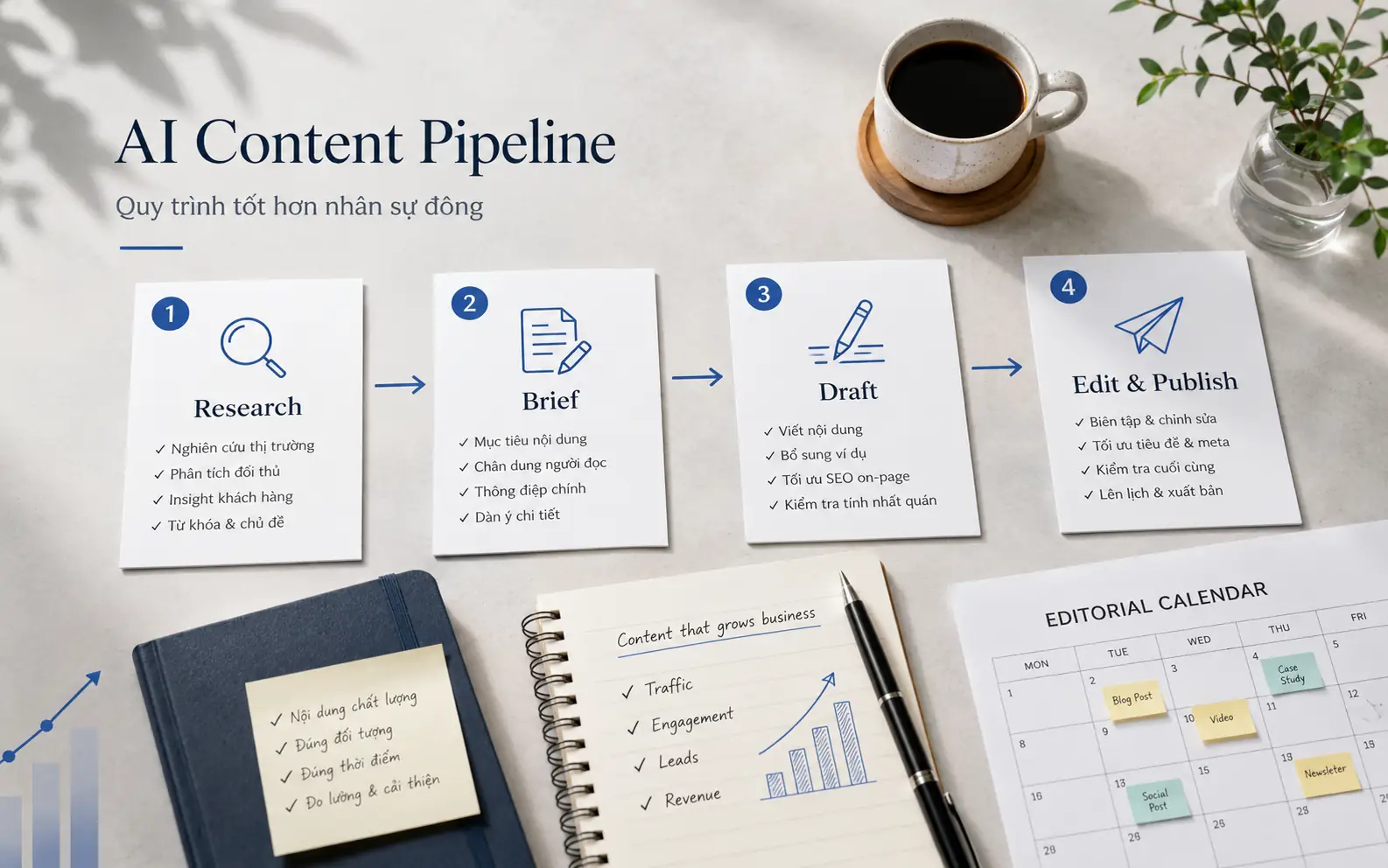
This post covers the four-stage AI content pipeline we build for clients, including the specific tools in each stage, the human review gates that maintain quality, and the results teams have achieved after implementing the system. If your team is currently producing fewer than four content pieces per week and struggling with consistency, this pipeline is directly applicable to your situation.
Why Most Content Pipelines Break
The typical content workflow at a small business looks like this: someone has an idea, they open a Google Doc, they write when they have time, the draft sits in review for two weeks, publishing gets delayed, and the SEO benefit of the piece is diluted by the time it goes live. This is not a talent problem.
It is an architecture problem. There is no defined handoff between research and writing, no template that tells the writer what to produce, and no automated pathway from approved draft to published and distributed post.
AI tools injected into this broken workflow make the problem worse, not better, because they increase output without increasing quality or reducing review time. The teams that fail with AI content are the ones that skipped workflow design.
The teams that succeed spent two to four weeks mapping their process before writing their first AI-assisted post. That investment pays back in the first month.
Stage One: Research and Brief Creation
The research stage produces the most important document in the entire pipeline: the content brief. A brief is not a topic or a title. It is a structured document that tells the writer or AI model exactly what to produce: the primary keyword and its search intent, a list of semantically related keywords to cover, the top three competing pieces and what they miss, the specific questions the post must answer, the required data points or statistics, the recommended structure, the target word count, and the internal links to include.
AI tools dramatically accelerate brief creation. Keyword clustering, competitor gap analysis, and audience question research that previously took a content strategist two full days can be completed in two to three hours using a combination of Semrush, Ahrefs, and a well-designed AI research prompt.
The human strategist's role shifts from manual data gathering to brief quality control. The output is a document that any competent writer, human or AI-assisted, can execute consistently.
What a Quality Content Brief Includes
- Primary keyword, monthly search volume, and intent classification (informational, commercial, navigational, transactional)
- Three to five semantically related keywords and sub-topics to cover
- Top three competing URLs and their identified content gaps
- Five to eight specific questions the post must directly answer
- Required statistics, data points, or first-hand examples to include
- Recommended H2 structure with each heading written as a question or explicit claim
- Target word count range and readTime estimate
- Suggested internal links to existing site content
- Meta title and meta description drafts for SEO review
Stage Two: AI-Assisted Drafting
Given a detailed brief, a large language model can produce a structurally sound first draft in under five minutes. We do not publish AI-generated drafts unedited.
What we do is use the AI draft as a structured scaffold that the human editor improves rather than builds from scratch. This shift from blank-page writing to structured editing cuts total writing time by 60 to 70 percent per post, and more importantly, it reduces the cognitive load that makes consistent publishing difficult for small teams.
The single most important principle in the drafting stage is that the AI prompt must include the complete brief. A prompt like 'write a blog post about AI content marketing' produces generic output.
A prompt that includes the target keyword, the required structure, the specific questions to answer, the brand voice guidelines, and three examples of the company's existing content produces a draft that requires editorial improvement rather than a complete rewrite. Prompt quality directly determines draft quality.
We maintain a library of tested prompt templates for each content type: educational blog posts, case study summaries, service page copy, email sequences, and social content. Teams that build this library early compound the efficiency gains over time because each template improves with each use. This is the core principle behind our AI content marketing service.
Stage Three: The Human Review Gate
The review stage is the non-negotiable human step that determines whether your AI pipeline produces quality content at scale or mediocre content at scale. Every draft that passes through stage two must be reviewed against a quality checklist before it moves to publishing. This checklist is not optional and it is not a formality.
Our standard review checklist covers five areas. Factual accuracy: every statistic, claim, and named example is verified against the original source. E-E-A-T signals: the post includes a named author, first-hand examples or client data, and external links to authoritative sources for all cited claims.
Brand voice: the post matches the brand's tone, vocabulary, and level of technicality for its audience. SEO elements: meta title and description are within character limits and include the primary keyword; all H2s appear in the brief; internal links are present and contextually relevant; schema markup is applied. Style compliance: no passive voice overuse, no AI-sounding hedging phrases, proper sentence length variation.
This checklist is what prevents the quality degradation that always occurs when teams prioritize volume without a quality gate. We have seen companies triple their content output using AI and watch their organic traffic decline because they removed the review gate to save time. The gate is not the bottleneck. Lack of a clear brief in stage one is always the bottleneck.
Stage Four: Distribution and Repurposing
Publishing a blog post and letting it sit on the website is not a content strategy. Distribution is the stage that multiplies the reach of each piece of content without proportionally multiplying the work. A single 1,500-word blog post, once reviewed and published, should become: three to five social media posts adapted for the platform's format and character limits, a section of a monthly email newsletter, the foundation of a short-form video script, a set of FAQs for the website, and a slide deck for internal or client presentations.
AI tools handle the adaptation layer, taking the approved long-form piece and generating platform-specific versions, in minutes. The human review for repurposed content is lighter than for original posts because the core content has already been verified.
A tool like Zapier or Make can automate the distribution workflow so that a published blog post triggers drafts in a social scheduling tool and a section placeholder in the email newsletter template simultaneously. The distribution stage, properly automated, requires about 20 minutes of human time per post rather than two hours.
Real Results From This Pipeline
A B2B SaaS client in the HR technology space came to us publishing two blog posts per month, both written entirely by their one content manager. Within eight weeks of implementing this pipeline, including three weeks of brief template design and tool setup, they were publishing 14 posts per month with the same one-person team. Their organic traffic increased 34% over the following quarter.
The traffic growth was not primarily from publishing volume. It was from the brief-first process forcing consistent search intent matching. Every post was now written around a keyword with verified demand and a defined user question.
Previously, topics had been chosen by gut feel and posts often addressed keywords with low or unclear intent. The pipeline removed that inconsistency. You can see the documented results of our content system implementations in our case studies.
How to Start Building Your Pipeline
The most common mistake teams make when building an AI content pipeline is starting with tool selection. The right order is process first, tools second. Begin by documenting your current content workflow exactly as it works today, including all the informal steps and manual handoffs.
Identify where content gets stuck and why. That diagnostic tells you exactly which stage of the pipeline needs the most structural improvement before any AI tool will help.
Stage one, brief creation, is where almost every team we have worked with needs the most improvement. If you can produce one high-quality brief per week for the first month and hold yourself to publishing only content produced from a complete brief, you will see the quality difference without any AI investment at all. AI accelerates a working process.
It cannot fix a broken one. If your team is ready to build a content system that compounds over time, contact us to discuss a pipeline design engagement.
Need help with this?
Growthtrait can help you put this into practice. Let's talk about your goals.
Contact us