
The most common thing I hear when I start an AI training session with a marketing team is: 'We have been using ChatGPT for a few months but we are not sure if we are using it right.' The answer is almost always the same: the team is using AI as a collection of individual productivity tools, not as a shared team system. Every person has their own prompts saved in their browser history. Nobody has documented what works.
When the one person who discovered a useful prompt leaves the company, the knowledge leaves with them. This is not an AI problem. It is a knowledge management problem.
This post explains the difference between a prompt and a system, the three-component framework every effective AI marketing system requires, the five highest-ROI systems for marketing teams to build first, and how to set up a quality review gate that maintains output standards as volume scales. This is the foundation we teach in our AI training workshops and implement for clients in our content engagements.
Prompts vs Systems: Why the Difference Matters
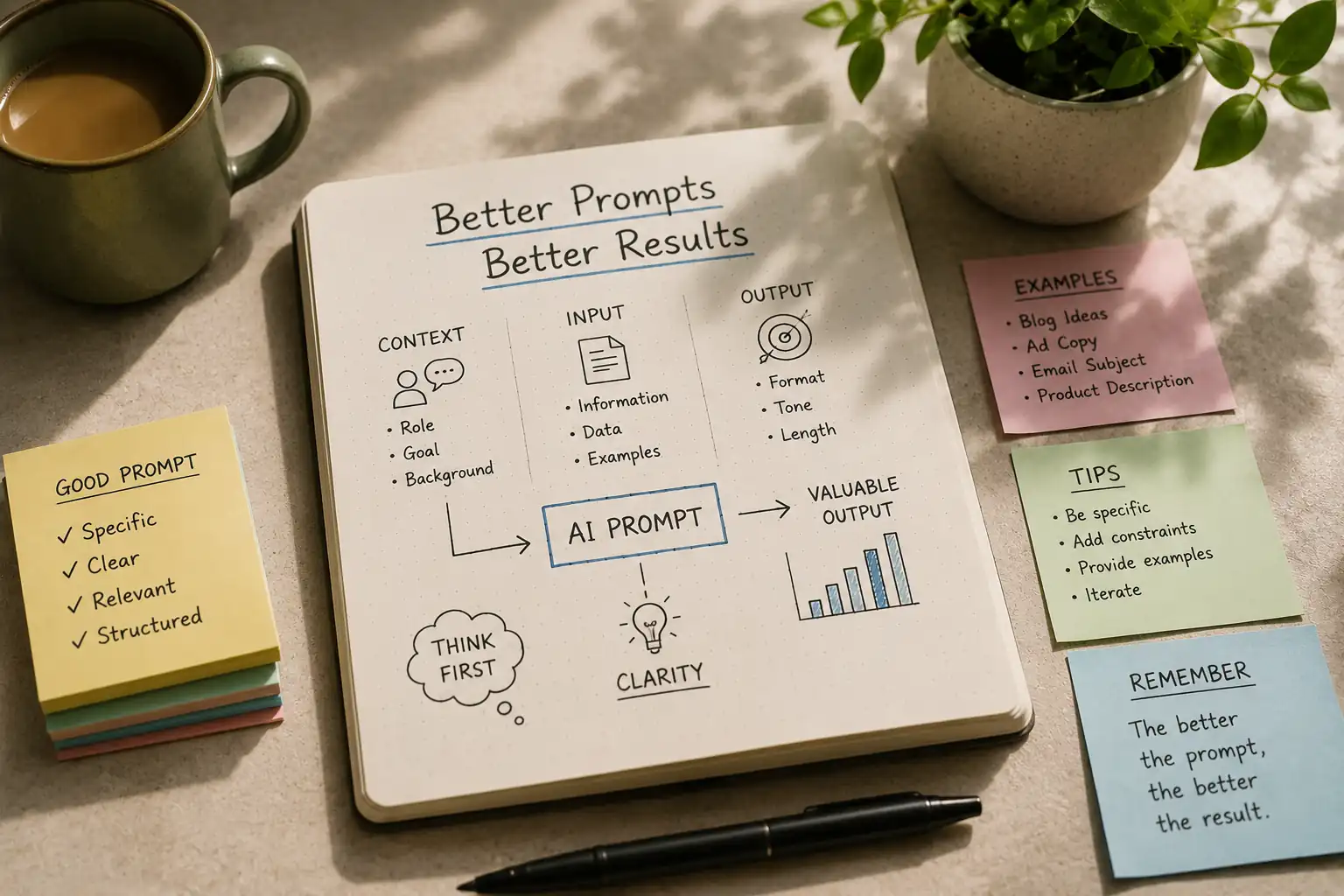
A prompt is a one-off instruction: 'Write a product description for this.' The output is unpredictable because the AI has no stable context about the brand, the audience, or the standards the output should meet. Run the same prompt tomorrow and you get a different result.
Show it to a colleague and they cannot replicate it. A prompt is personal productivity: better than nothing, but not scalable.
A system is a documented, reusable workflow with five components: a context block (everything the AI needs to know about the brand, audience, tone, and constraints), a task definition (precisely what the output should contain and what it should not), an input template (a structured format that any team member fills in to trigger the workflow), a quality checklist (explicit criteria the human reviewer applies before using the output), and a delivery mechanism (how the output moves to the next stage of the publishing process). The output of a system is predictable and consistent. The output of a one-off prompt is not.
When marketing velocity matters, and it always does, you need the system model, not the prompt model. The system model scales because any team member can run it, new hires can learn it in hours, and the knowledge is stored in the document, not in one person's memory.
The Three-Component Framework for Every AI Marketing System
Every effective AI marketing system we build has three core components. Getting all three right is what separates systems that teams actually use from systems that feel good to design but fail in practice.
Component One: Context Block
The context block is the most important part of any AI system and the most commonly skipped. It is the set of information the AI needs to understand before executing a task: brand name and description, target audience with specific demographics and pain points, tone of voice guidelines with examples, vocabulary the brand uses and does not use, competitor names to avoid mentioning positively, product or service details, and any compliance or legal constraints. This context block is written once and included in every system prompt in the library.
Teams that skip the context block get generic output. Teams that invest two hours in writing a thorough context block get brand-consistent output on every run.
Component Two: Task Definition
The task definition is the specific instruction that tells the AI what to produce, in what format, at what length, and with what required elements. A weak task definition: 'Write a LinkedIn post about our new product feature.' A strong task definition: 'Write a LinkedIn post of 150 to 200 words about the following product feature. The post should open with a specific problem the reader recognizes in their own work.
The body should explain how the feature solves that problem in concrete terms with one specific example. The closing should include a single question that invites comments. Do not use corporate jargon.
Do not use hashtags. End with a plain call to action without exclamation marks.' The specificity of the task definition directly determines the quality of the output.
Component Three: Quality Checklist
The quality checklist is the human review gate. It is a numbered list of criteria that the reviewer applies to every output before using it. A checklist for a social post might include: Does the post open with a problem statement rather than a product feature?
Is it within the word count range? Does it match the brand tone guidelines? Does it avoid banned vocabulary from the brand guide?
Is there exactly one CTA? Would I be comfortable if this were attributed to our brand publicly? The checklist does two things: it makes review faster because the reviewer knows exactly what to look for, and it maintains quality as volume scales because the standard is explicit rather than depending on the reviewer's mood.
The Five Highest-ROI AI Systems for Marketing Teams
Based on the training programs we have run with marketing teams across Vietnam, Australia, and the United States, these five AI systems consistently produce the highest return relative to the time invested in building them.
- Blog-to-social repurposing: a system that takes a published blog post and generates platform-specific social posts for LinkedIn, Instagram, and Facebook. Once built, this system generates a week of social content in 20 minutes from a single approved article.
- SEO meta batch generator: a system that takes a list of page URLs and target keywords and generates optimized meta titles and meta descriptions for each. For sites with 50 or more pages, this system alone justifies the AI investment.
- Email nurture sequence builder: a system that takes a customer journey stage and a target audience segment as inputs and generates a 5-email sequence with subject lines, body copy, and CTAs. Reduces email production time by 70 percent.
- Ad copy variation generator: a system that takes one approved ad headline and generates 10 to 15 variations testing different emotional hooks, benefit framings, and urgency levels for A/B testing.
- Competitor positioning summary: a system that takes a competitor URL as input and produces a structured summary of their positioning, messaging, key claims, and identified weaknesses for competitive analysis.
Building a Shared Prompt Library
The technical infrastructure for a shared AI system library does not need to be sophisticated. A well-organized folder in Notion, Google Drive, or Confluence with a consistent file structure per system is sufficient for teams of up to 20 people. Each system document should include: the context block in a clearly labeled section, the task definition prompt ready to copy and paste, the input template the team member fills in, the quality checklist, and two to three example outputs that demonstrate the expected standard.
The organizational discipline that matters most is version control. When a system is improved, for example a new context detail is added or the task definition is refined based on output patterns, the date of the update should be logged and the reason for the change noted. This creates an institutional record of what works and why, which is especially valuable when onboarding new team members or revisiting a system after several months.
Tools like ChatGPT, Claude, and Gemini all support system prompts or custom instructions that can be pre-loaded with your context block, reducing the manual copy-paste step for everyday use. For teams doing high volume, tools like Make or Zapier can automate the input-to-output workflow so that filling in a form triggers the AI system and delivers the output to the right place in your publishing pipeline.
Quality Control at Scale
The quality concern around AI-generated content is legitimate and worth addressing directly. Without a review gate, output quality degrades over time as AI models shift, context drifts, and team members stop checking carefully because they assume the system is reliable. Quality degradation at scale is harder to detect and more expensive to reverse than individual low-quality posts.
The review gate must be explicitly required, not optional. The way to make it stick culturally is to frame it accurately: the AI is not the quality assurance mechanism. The AI is the production mechanism.
Quality assurance is a human responsibility. Teams that treat AI output as final copy consistently produce lower-quality content than teams that treat AI output as a first draft that needs improvement.
The distinction is not about distrust of AI. It is about where responsibility for accuracy and brand representation correctly sits.
We run structured two-day AI marketing workshops for teams that want to move from ad hoc AI use to documented systems. The workshop covers context block writing, task definition practice, quality checklist design, and hands-on system building for each team's specific content types.
Teams that complete the workshop leave with four to six operational systems and the methodology to build more. For teams that want their systems built alongside them by practitioners who use these methods daily, our AI content marketing service includes full system design, documentation, and team training. Contact us to discuss what is right for your team's size and goals.
Need help with this?
Growthtrait can help you put this into practice. Let's talk about your goals.
Contact us