

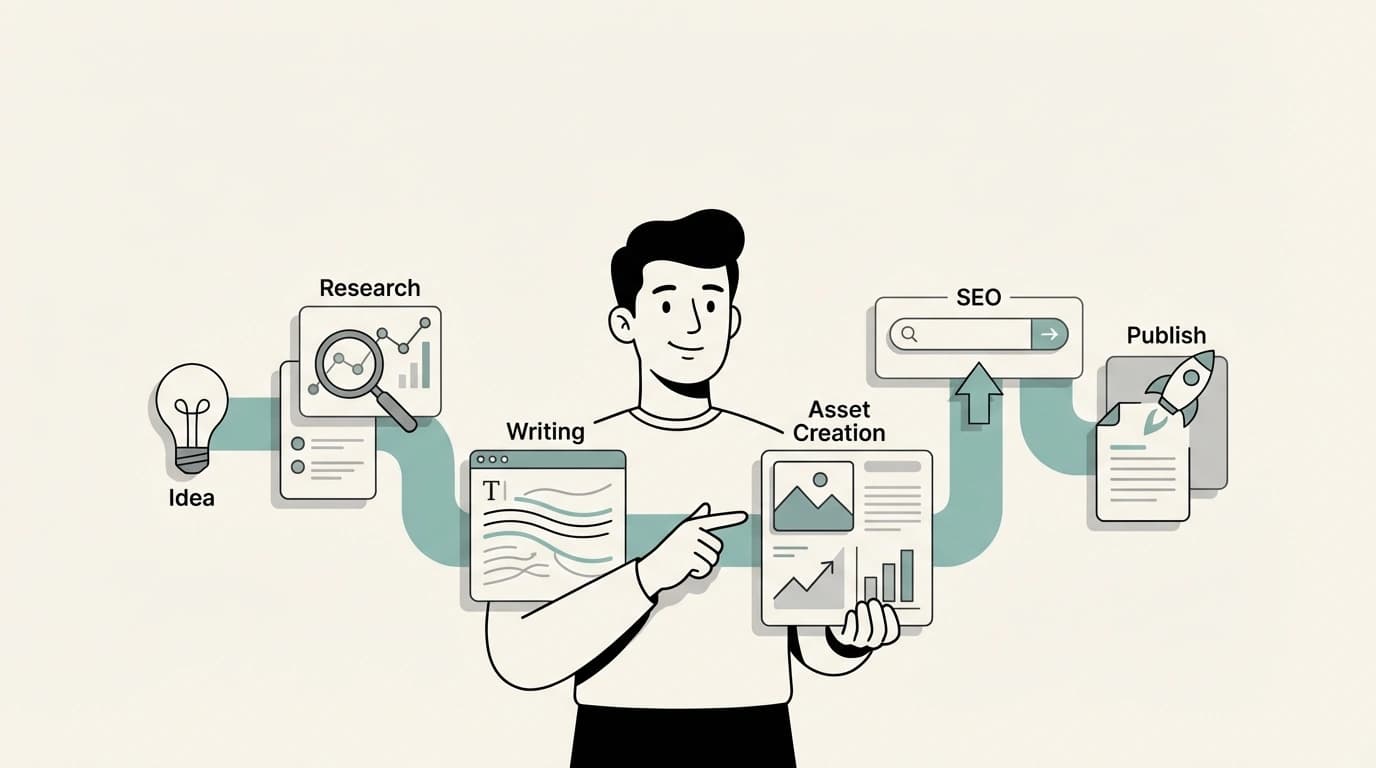
We published a guide a while back on building an AI content pipeline, and it opens at Stage One: research and brief creation. A reader wrote in to point out, correctly, that the whole thing quietly assumes you already know what you are writing about. The brief is where the pipeline starts. But the idea comes from somewhere, and for most teams that somewhere is a spreadsheet of keywords, a competitor's blog, and whatever the founder mentioned on Monday.
That gap used to be survivable. When the marginal cost of a blog post was high and the payoff for ranking was reliable, a mediocre idea executed well still returned something. That is no longer true. AI has collapsed the cost of production, which means everyone is producing, and AI Overviews have simultaneously started absorbing the traffic that used to reward the safest and most obvious topics.
This post is the missing stage: how to source ideas from places that are not keyword tools, how to score them so the weak ones die before anyone writes a brief, and how to run an idea backlog that compounds instead of rotting.
Why Idea Selection Became the Bottleneck
For a decade, the constraint on content marketing was throughput. Teams could not write enough, fast enough, so any system that increased output increased results. That is the assumption baked into most content operations, and it is now inverted.
When a small team can produce twenty pieces a month, output stops being a differentiator and starts being a liability. Twenty pieces aimed at the wrong questions is twenty times the cost of one, with the same return. The scarce resource is no longer writing capacity. It is judgment about what deserves the capacity.
The teams we work with who are still growing organic traffic are not the ones publishing most. They are the ones killing the most ideas before the brief stage.
The Intent Mix Shifted and Most Topic Lists Did Not
Here is the data that should change how you pick topics.
Semrush's analysis of AI Overviews found a trigger rate of roughly 39.4% for informational searches, far above the rate for commercial and transactional queries. Seer Interactive found a similar shape in their own data: AI Overviews appearing in around 36% of informational queries, against 8% of commercial and 5% of transactional ones.
Read that as a map of where the click still exists. If you are writing a definitional or explanatory post, there is a meaningful chance Google answers the question above your result and the user never arrives. If you are writing for someone comparing options or ready to act, the click has been considerably more durable.
But the map is moving, and this is the part most content teams have not internalised. In January 2025, 91.3% of the queries that triggered an AI Overview were informational. By October that share had fallen to 57.1% as commercial and transactional AI Overviews rose. In a separate six month study of more than 600,000 keywords across ten industries, Semrush found AI Overviews grew an average of 71% on SERPs with commercial intent.
So the safe harbour is shrinking. Choosing commercial intent topics is still the right call, but it is not a permanent moat, and any idea pipeline that scores ideas purely on search volume is scoring them on the one variable that has become least predictive of outcome.
Five Sources of Ideas That Are Not Keyword Tools
Keyword tools tell you what people have already searched enough times to be measured. That makes them a lagging indicator, and it makes everyone who uses them arrive at the same list. The ideas that are actually worth your production capacity come from places your competitors are not looking.
- Sales call recordings. The objection a prospect raises in minute forty of a call is a content brief with the research already done. Nobody is searching for it in those words yet, which is exactly why writing it wins.
- Your own Search Console query data, filtered to high impression and low click. These are queries where Google already thinks you are relevant but users are not choosing you. That is a page level content problem you can diagnose and fix, and it is the cheapest traffic on the table.
- Support tickets and customer questions. If five customers asked it, five thousand prospects wondered it. Support inboxes are the single most underused idea source in most companies.
- The prompts buyers type into AI assistants. Ask your last ten customers what they asked ChatGPT or Claude while they were evaluating. The phrasing is different from search phrasing, longer and more conversational, and almost nobody is writing to it.
- Competitor content gaps, read honestly. Not what they wrote, but what they carefully avoided writing because the honest answer would not flatter them. That is where a credible, non defensive answer becomes uniquely citable.
Scoring an Idea: Four Questions, Then Kill or Keep
A backlog without a scoring model is a wish list. The point of scoring is not precision, it is forcing an explicit decision so that weak ideas die on a rubric rather than lingering because nobody wants to be the person who says no.
Four questions, scored one to five. An idea that cannot clear a threshold on all four does not proceed to a brief.
- Does the click survive? Given the intent behind this query, will a user who sees an AI answer still have a reason to open the page? If the entire value of the piece can be summarised in three sentences, an AI system will summarise it in three sentences.
- Can we answer this better than anyone currently does? Not longer. Better. If we have no first hand data, no client example, and no genuine point of view, we are producing a commodity and we will be treated as one.
- Does it map to something we sell? Not every piece needs to convert, but every piece should sit on a path that leads somewhere. An article that no service page could plausibly link to is an article that will never pay for itself.
- Does it strengthen a cluster we are already building? A piece that reinforces existing topical depth is worth more than an equally good piece that stands alone, because authority compounds within a topic and does not transfer across unrelated ones.
The first question is the one that is new, and it is the one most teams skip. It is also the one that will kill a large share of the safe, obvious, definitional topics that keyword tools push to the top of your list.
Running the Backlog So It Does Not Rot
An idea backlog is only an asset if it is trusted, and it stops being trusted the moment it becomes a graveyard. Three rules keep ours alive.
Capture is cheap and unfiltered. Anyone can add an idea, in one line, with no obligation to justify it. Raising the bar at capture time means good ideas never get written down because someone was busy.
Scoring is scheduled and ruthless. Once a week, someone scores every new idea against the four questions and moves it to briefed, parked, or killed. Not scoring is worse than scoring badly, because an unscored backlog silently becomes an unsorted pile that nobody reads.
Killed means killed. The single most common failure is a backlog where nothing is ever removed, only deprioritised, until the list is four hundred items long and everybody has quietly stopped opening it. Delete things. If an idea is genuinely good it will resurface, because good ideas keep coming back.
What This Feeds
The output of this stage is not a title. It is a decision, with a reason attached, that a specific idea is worth a brief. That decision is what Stage One of the content pipeline has always assumed and never produced.
Once an idea clears scoring, everything downstream gets easier and cheaper, because the hard thinking has already happened. The brief writes faster, because the reason the piece exists is already articulated. The draft is stronger, because the writer knows what makes this piece different from the twenty existing ones on the topic. And the review gate has an actual standard to review against, rather than a vague sense of whether the post is any good.
The compounding effect is real but it is slow, and it does not show up as a traffic spike. It shows up as a content library where a large majority of the pieces are still earning attention a year later, instead of the more typical pattern where a small handful carries everything and the rest were never worth writing.
Where to Start This Week
Do not build the system first. Open Search Console, filter to queries with high impressions and low clicks, and read the top thirty. Then open the recordings of your last five sales calls and write down every question a prospect asked that your content does not answer.
That is your first backlog, and it will be better than anything a keyword tool would have given you, because it is drawn from demand that already exists and that your competitors cannot see. Score it against the four questions, kill half of it, and brief what survives.
The pieces that come out the other side are the ones worth putting through a production system at all. If you want help building an idea and production system your team will actually run, that is exactly what our AI content and creative production service is designed to do. You can see the approach and the results at Growthtrait and in our case studies, or contact us to talk through what your team is currently getting stuck on.
Need help with this?
Growthtrait can help you put this into practice. Let's talk about your goals.
Contact us