
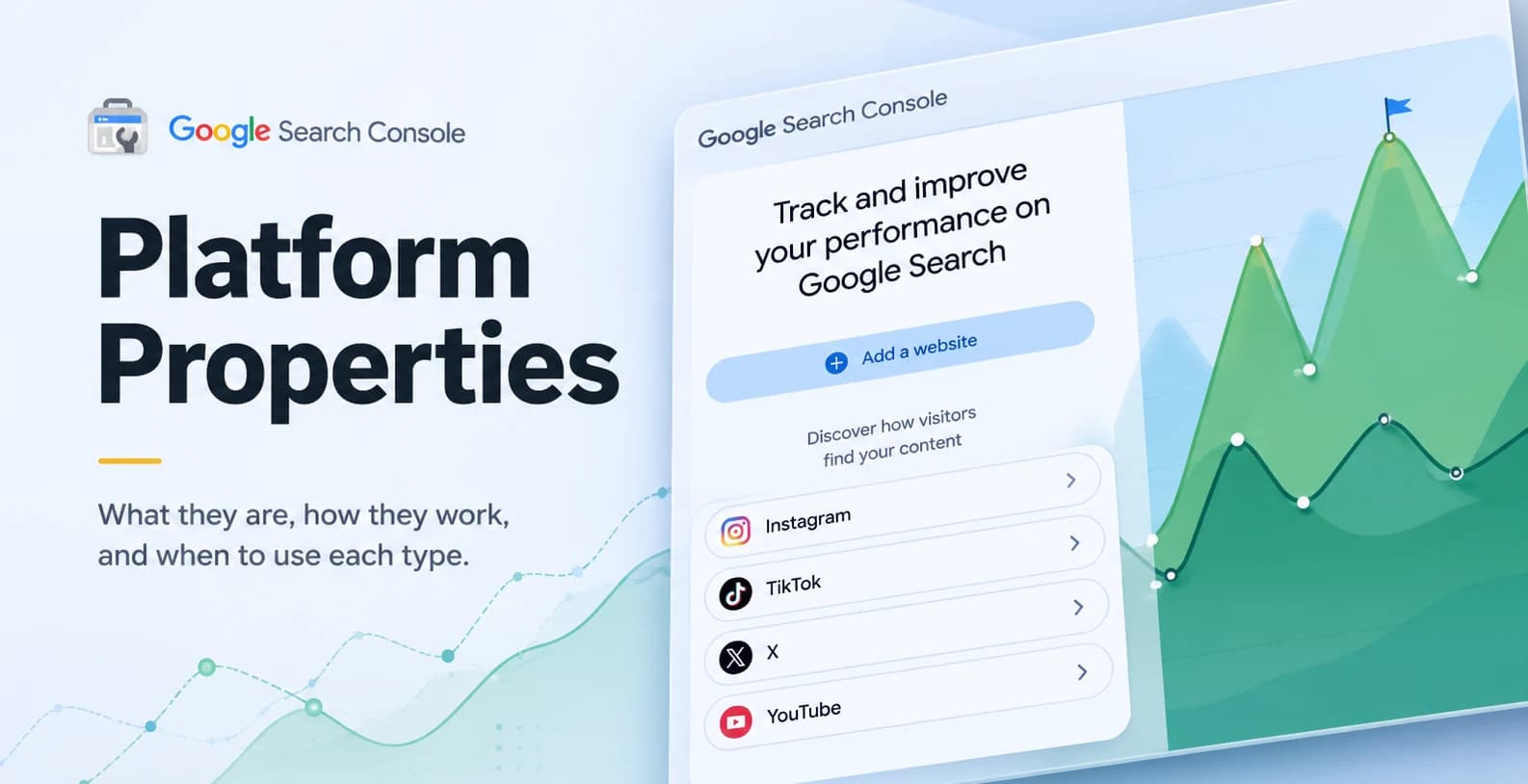
For years there was a clean line running through Search Console. If you owned a website, you got data. If you built your audience on TikTok, Instagram, X, or YouTube, you got nothing, at least not from Google's own tools. Your posts might have been showing up in Google Search and quietly sending you traffic, and you had no way to see any of it.
That line just moved. In July 2026, Google introduced platform properties, a new kind of Search Console property that reports how your social and video content performs in Google Search and Discover. It is the first property type you can verify without owning a domain, which is a real shift for anyone whose audience lives on social platforms.
Here is what platform properties actually do, what they leave out, and how to get something useful out of the data once you have it.
What Are Platform Properties in Search Console?
Search Console has always had two property types, and both assume you own a website. A domain property covers every subdomain and protocol under a domain and is verified through DNS. A URL prefix property covers a single URL version and is verified with an HTML file, a meta tag, or an analytics connection.
Platform properties are a third type, and they work on a different logic. Instead of proving you control a domain, you connect a social account. Once it is verified, Search Console reports on how that account's posts perform in Google Search, using the same core metrics website owners already lean on. According to Google's Search Console documentation, the data spans Google Search, Discover, and Google News.
Which Platforms Are Supported, and What Data Do You Get?
At launch, platform properties support four platforms: Instagram, TikTok, X, and YouTube. Each account is its own property, so if you run three channels, you verify three properties.
Google splits the data across three reports:
- Performance shows the numbers SEOs care about: clicks, impressions, average click-through rate, average position, and the actual search queries that surfaced your content.
- Insights gives a higher-level read on your traffic trends and top-performing posts.
- Achievements flags milestones your content reaches over time.
The most valuable piece is the query data. For the first time, a creator can see the exact searches that led someone from Google to their TikTok video or Instagram post. Not an estimate, but Google's own numbers.
What Platform Properties Do Not Show
This part is worth being blunt about, because it is easy to expect more than the feature delivers. Platform properties only measure how your content performs on Google. They do not touch what happens on the platform itself.
A TikTok property will not tell you how many times your video played inside TikTok. An Instagram property will not show story views or in-app engagement. Google is reporting only the slice of attention that flows through Search, Discover, and News. Your native platform analytics still cover everything else, and you will want both to see the full picture.
How Do You Set Up a Platform Property?
The setup is quick, usually a couple of minutes. Open Search Console, choose Add property, pick one of the four platforms, and follow the prompts to sign in to that platform and authorize the connection. Verification runs through the platform's own login rather than a DNS record or a file upload.
Two things to keep in mind. Data does not appear right away, so expect a few days before the reports fill in. And Google rechecks ownership periodically, which means if that platform login expires or the connection drops, the property pauses until you reconnect it.
One note on availability: Google is rolling this out gradually rather than switching it on for everyone at once. If you do not see the option yet, it is not missing, it simply has not reached your account. Check the Add property menu again in a week or two.
Why Does This Matter for Creators and Brands?
The obvious win is measurement. Social teams have spent years optimizing for platform algorithms while flying blind on the search traffic their content pulls in. Platform properties close that gap, and as Tubefilter noted in its coverage, they turn Google Search data into an asset creators can actually act on.
There is a larger context here too. Google keeps surfacing social and video content directly in results and in Discover, and a growing share of searches ends without a click to a traditional website. When your visibility lives inside Google's own surfaces, being able to measure it is the first step to growing it. This is the same shift that makes GEO and AEO worth taking seriously: search is no longer only about ranking a webpage.
What Should You Do With the Data?
Once your reports fill in, a few moves pay off fast:
- Read the query report first. The searches sending people to your posts tell you what Google already associates your content with, which is useful for titles, captions, and deciding what to make next.
- Find your winners. Sort by clicks and impressions to see which posts actually pull search traffic, then make more in that direction instead of guessing.
- Watch position against clicks. If a post earns impressions but few clicks, the snippet or thumbnail is usually the weak link, not the topic.
- Treat it as a companion to native analytics, not a replacement. Google shows you the search side, the platform shows you the rest.
Where This Goes Next
Platform properties are new, and Google will almost certainly expand what they report over the coming months. The direction is already clear though: the wall between social content and search visibility is coming down, and the brands that measure both will move faster than the ones still treating them as separate worlds.
If you want help turning this data into a plan, whether that means optimizing social content for search or building a strategy that spans your website and your channels, our SEO and AI search service is built for exactly this kind of cross-surface work. Contact us and we will take a look at where you stand.
Need help with this?
Growthtrait can help you put this into practice. Let's talk about your goals.
Contact us