
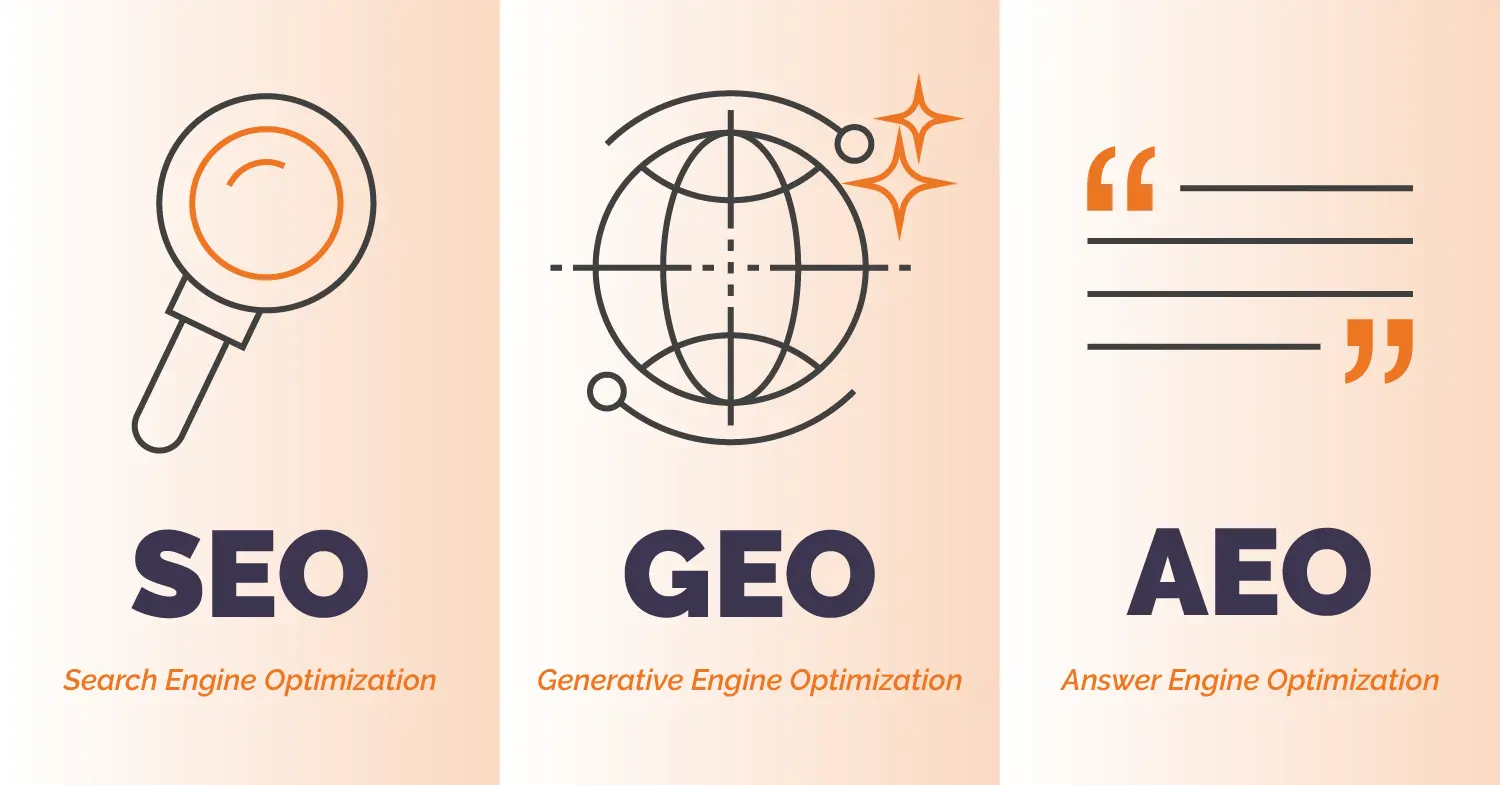
In recent client calls, the same question keeps coming up in different words: are SEO, AEO and GEO the same thing, and if not, which one should come first. The three acronyms get used interchangeably across a lot of marketing content, but they measure three genuinely different outcomes across three different search surfaces.
According to BrightEdge data from early 2026, Google AI Overviews now appear on roughly 48% of tracked search queries, up 58% year over year. At the same time, Search Engine Land reported that traffic referred from AI platforms such as ChatGPT, Perplexity and Gemini grew 527% in the first five months of 2025 alone. Those two numbers describe two different phenomena, and that difference is exactly why SEO, AEO and GEO need to be told apart rather than treated as synonyms.
This guide breaks down what each term actually means, how they work differently under the hood, and a practical framework for prioritizing all three instead of picking one.
What Is SEO and What Does It Optimize For?
SEO (Search Engine Optimization) is the set of practices that gets a page crawled, indexed and ranked highly in classic organic search results on Google or Bing for a given query. The unit SEO wins on is ranking position and clicks, measured through keyword rankings, organic traffic and click through rate in Google Search Console.
It is the model that has existed since the late 1990s, built on three familiar pillars: keywords and relevance, backlinks and domain authority, and technical experience such as page speed and crawlability. Most SEO work today still revolves around these three pillars.
What Is AEO and How Is It Different From SEO?
AEO (Answer Engine Optimization) is the practice of structuring content so answer engines, including Google AI Overviews, featured snippets, and voice assistants such as Siri or Google Assistant, can extract a direct answer straight from your page. The goal is not a high ranking, it is becoming the answer that gets shown, often above the ranked results entirely.
The core difference is this. SEO optimizes a page to earn a spot in a list a user then chooses from. AEO optimizes a specific passage so a system can lift it out as the answer, frequently before any link is ever clicked. The factors with the strongest impact on being cited by AEO are E-E-A-T signals, Schema.org structured data, and a direct, concise answer placed right at the top of the content.
See our full definition of AEO for more detail.
What Is GEO and Why Is It Not the Same as AEO?
GEO (Generative Engine Optimization) is the broader term, formalized in an academic paper by researchers at Princeton University, IIT Delhi, Georgia Tech and the Allen Institute for AI, published at KDD 2024. The paper built GEO-bench, a 10,000-query benchmark, and tested nine content tactics, five of which boosted AI citation rates by up to 40%.
GEO focuses on getting content absorbed by large language models such as ChatGPT, Perplexity, Gemini and Claude, then woven into a synthesized, narrative answer. Unlike AEO, where your page becomes the entire answer, GEO aims to become one of several sources cited inside a longer passage the AI writes in its own words. Our GEO vs SEO guide goes deeper into applying this in practice, and the full definition lives in our GEO glossary entry.
Where Do SEO, AEO and GEO Actually Differ?
The three disciplines share most of their technical foundation, but differ sharply on four points.
- Surface: SEO shows up on the classic results page. AEO shows up in a direct answer box or featured snippet. GEO shows up inside a synthesized answer from ChatGPT, Perplexity, Gemini or AI Overviews.
- Unit of success: SEO wins on ranking position. AEO wins by becoming the single answer shown. GEO wins by being named or cited alongside other sources.
- How the system processes it: SEO runs on crawl, index, rank. AEO runs on extracting the single best passage. GEO runs on retrieval followed by generation, where a model synthesizes an answer in its own language.
- What gets measured: SEO is measured by ranking and organic traffic. AEO is measured by presence in answer boxes. GEO is measured by citation rate and share of voice inside AI answers.
Does One of These Replace the Others?
No, and this is the most common misunderstanding. GEO and AEO do not replace SEO, they build on top of it. Generative AI models still rely on many of the same authority and relevance signals as traditional search algorithms, including quality backlinks, page speed and author credibility. A page with a weak SEO foundation has almost no chance of being cited by AI, because the model still has to find and trust that page before it can cite it.
In terms of scope, AEO can be thought of as a subset of GEO. AEO targets becoming the single winning answer in an answer box. GEO targets being woven in as one of several cited sources inside a longer, AI authored narrative. In practice, the two disciplines overlap on roughly 80% of the actual optimization work.
What Should You Measure for AEO and GEO?
SEO has a familiar metric set: keyword rankings, organic traffic, click through rate from Google Search Console. AEO and GEO need a different set of metrics, because there is no single fixed position to track.
- Mention rate: the share of tracked queries where an AI system names your brand in its answer.
- Citation rate: the share of AI answers that include a link back to your website, generally treated as the single most important AEO and GEO metric.
- Share of voice: the percentage of AI answers mentioning your brand versus competitors for the same set of target queries.
The simplest way to start measuring without paid tooling is to manually run ten prompts a real customer would type into ChatGPT or Gemini, record who gets named and which sources get cited, and repeat monthly.
Applying All Three to Your Website
The right priority is not choosing one of the three, it is building a solid SEO foundation first, layering in AEO friendly formats such as schema marked FAQ sections and a direct answer at the top of each page, then extending into GEO by citing sourced statistics, using comparison formats, and building topical authority through internally linked content clusters.
This is exactly how our SEO and AI search service is structured: one strategy covering technical SEO, content, topical authority and Generative Engine Optimization, instead of three separate workstreams. If you want to know where your website currently stands across all three, contact Growthtrait to talk through an audit.
Need help with this?
Growthtrait can help you put this into practice. Let's talk about your goals.
Contact us