
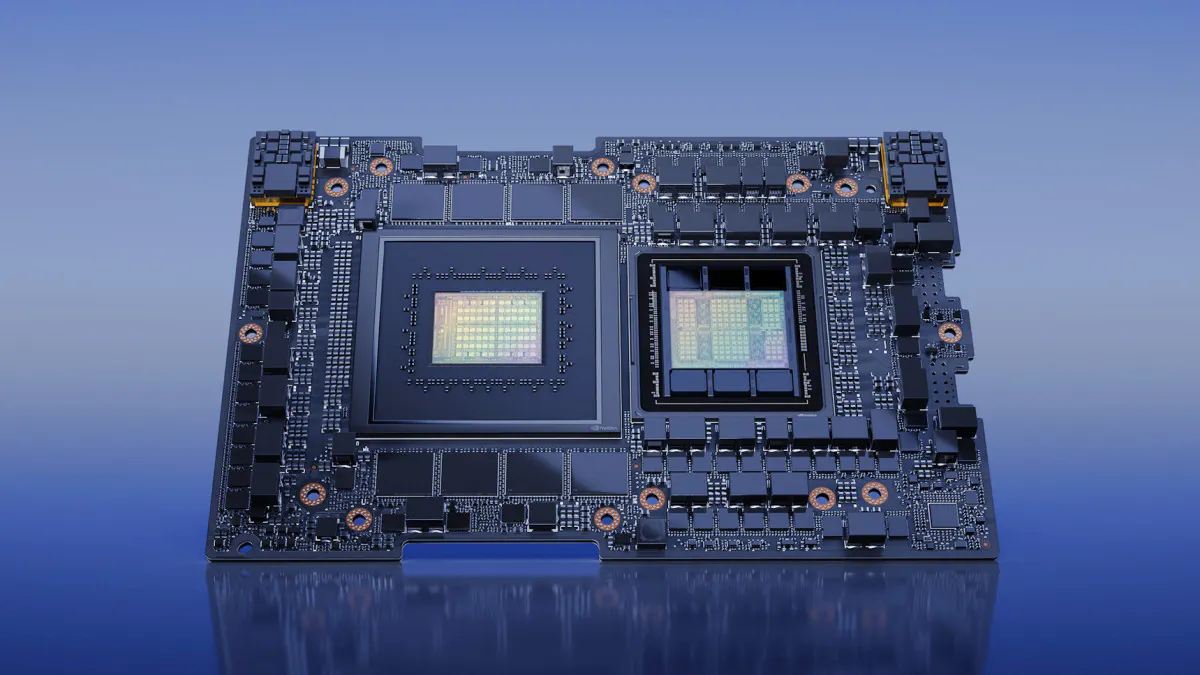
For more than three decades, Nvidia and Jensen Huang were almost the same thing in the public mind. He co-founded the company in 1993, ran it as CEO from the start, and led it through the shift from gaming graphics to the chips that power most of today's AI. When a company sits at the center of an entire industry's supply chain, a change at the top is not only a company story. It raises questions for chipmakers, cloud providers, AI labs and every business that depends on them.
On November 12, 2026, Nvidia announced that Huang had resigned as President, Chief Executive Officer and board member, effective immediately, and that Chief Financial Officer Colette Kress would serve as interim CEO. This article sets out what is confirmed, what markets did in the first days, how the change could affect the chip and AI market, and which signals will show whether the impact is temporary or lasting.
We rely on primary sources first, Nvidia's own filings and statements, and clearly label analyst views as opinions. This article reflects information available on November 14, 2026, and will be updated as Nvidia reports results and names a permanent CEO.
What Has Nvidia Officially Confirmed?
Nvidia disclosed the change in a Form 8-K filed with the SEC and a press release. The key facts:
- The board accepted Huang's resignation as President, CEO and director on November 11, 2026, effective immediately.
- Colette Kress, Executive Vice President and CFO since 2013, was appointed interim CEO and continues as CFO until a permanent successor is named.
- Harvey C. Jones, a director since 1993 and former CEO of Synopsys, was appointed the company's first-ever Chair of the Board.
- The board is “initiating a search for a permanent Chief Executive Officer and will consider internal and external candidates.” No timeline or search firm was named.
- Nvidia said it expects “operations, customer commitments and product roadmap to continue without interruption.”
- Third-quarter fiscal 2027 results remain scheduled for November 17, 2026.
Neither document gives a reason for the resignation. Separately, on November 10 the independent members of the board said they had retained outside counsel to conduct “a thorough and independent investigation.” Nvidia has not published findings.
Why Nvidia's Leadership Matters to the Whole AI Market
Few companies are as central to a technology wave as Nvidia is to AI. Its own numbers show the scale. In the quarter that ended July 26, 2026, Nvidia reported revenue of $96.2 billion, up 106% from a year earlier, with $89.0 billion from its data center business. It guided to about $108 billion for the following quarter, without assuming any data center compute revenue from China.
Nvidia is also a major investor and financier across the AI industry. According to TechCrunch, it held about $99 billion in investments and $25 billion in commitments as of its second quarter, including stakes in AI labs and cloud providers and up to $105 billion in credit guarantees tied to an OpenAI data center campus. Its sales are concentrated too: according to its annual report, one direct customer represented 22% of total revenue in fiscal year 2026 and another represented 14%.
That combination of scale, customer concentration and ecosystem investment is why a leadership change at Nvidia is watched far beyond its own shareholders.
How Did Markets React?
Nvidia's stock
- November 12: shares fell as much as 14% to 16% during the day, according to different reports, then recovered to close down about 4.3%, according to CNBC and NBC News.
- November 13: shares fell another 2.01%, closing below $4 trillion in market value for the first time since July 2025, according to CNBC.
- The week: the stock fell 12.75%, its sixth straight weekly decline. It was already down more than 20% over the previous month, so not all of the weakness is tied to the leadership change.
The wider chip sector
The first-day reaction was largely specific to Nvidia. On November 12 the PHLX Semiconductor Index fell only about 0.5%, while AMD rose 5.9% and Broadcom 5.5%, as some investors bet that competitors could gain share, according to NBC News and Kiplinger. William Blair upgraded AMD that morning, saying the “risk/reward has shifted in AMD's favor.”
On November 13 the mood broadened. AMD fell about 8%, Broadcom about 4%, SK Hynix about 4%, and Intel, Micron and TSMC each fell between 1% and 2%, according to Yahoo Finance. AI cloud providers that depend on Nvidia's chips and financing, such as CoreWeave and Nebius, had already fallen sharply on November 12, though Nebius was also reacting to its own disappointing guidance. Coverage also pointed to existing worries about the pace of AI infrastructure spending and possible tighter regulation.
What analysts said
Analyst views split, which is typical in the first days of a leadership change:
- More cautious: Bernstein cut its price target from $400 to $200, with analyst Stacy Rasgon saying of the succession question, “I don't intuitively know who that person would be.” Cantor Fitzgerald cut its target from $350 to $250 while keeping an overweight rating, and said the key question is how Nvidia maintains “its technological roadmap over the coming five years.”
- More patient: JPMorgan said it expects the Nvidia team “to maintain its leadership in AI.” Mark Malek of Siebert Financial said, “The market may be confusing the value of Jensen Huang with the value of NVIDIA.”
Five Ways a CEO Change at Nvidia Can Affect the Chip and AI Market
1. Product roadmap: short term stable, long term open
Advanced chips are designed years before they ship, and manufacturing runs through partners such as TSMC under long-term plans. That makes the near-term product pipeline the part least likely to change: products already in development and committed to customers are not usually redesigned because of a CEO change. The open question is the next cycle of big strategic bets, such as which architectures, software platforms and markets to prioritize from 2028 onward. That is where a founder's long-term vision mattered most, and where the next CEO will be judged.
2. Customers and competition
Large buyers of AI chips, the cloud providers and AI labs, already spread purchases across suppliers where they can. A period of leadership uncertainty can encourage more of that. AMD's competing rack-scale systems are already deployed at several major AI customers, which is why its stock rose on day one. But switching is slow: Nvidia's advantage rests heavily on its CUDA software ecosystem and on supply commitments planned far in advance, and analysts noted that competitors could not supply the whole market even if customers wanted to switch at once. Any shift in market share is therefore more likely to show up gradually over several product cycles than in a sudden move.
3. The AI financing web
Nvidia has become a financier of the AI build-out, through equity stakes, cloud capacity commitments and credit support. Deals of that kind often depend on senior relationships and long-term conviction at the top. An interim leadership team led by a CFO may reasonably prioritize discipline over new large commitments. If the pace of new Nvidia-backed financing slows, the effect would be felt most by smaller AI cloud providers and startups that rely on it, which helps explain why those stocks reacted strongly.
4. Export controls and policy
Nvidia sits at the center of US export policy on advanced chips, especially for China. Before the resignation was announced, JPMorgan analysts said “the risk of more restrictive guidelines on shipments directly or indirectly into China has risen.” Nvidia's guidance already excluded China data center compute revenue, which limits the direct near-term revenue exposure. The wider effect is on policy: closer scrutiny of export approvals could shape rules for the whole industry, not only Nvidia.
5. Governance and key person risk
Before this change, Nvidia's board had no chair, and Huang ran a famously flat organization with around 60 direct reports, according to TechCrunch, which also reported that there was no publicly identified heir apparent. Nvidia's own annual report had flagged this kind of risk, stating that “we are highly dependent on the services of our longstanding executive team” and warning about the consequences of failing “to ensure effective succession planning, transfer of knowledge, and smooth transitions.” Appointing a first-ever independent chair is a structural governance change. For investors across the AI sector, the episode is a reminder that many of the most valuable AI companies are still led by founders who are hard to replace, and that succession planning is a real business risk, not a formality.
How Founder CEO Transitions Usually Play Out
History offers useful context without predicting the outcome. Apple named Tim Cook CEO in 2011 after Steve Jobs stepped down, and Microsoft named Satya Nadella CEO in 2014 after a long founder-led era. In both cases, the successor came from inside the company, and the strategy that followed differed meaningfully from the founder era.
The general pattern is that markets price uncertainty quickly, while the real effects of a leadership change show up over years, in which products get prioritized, how partnerships are managed and whether key people stay. The first week's stock move says more about uncertainty than about long-term value.
What to Watch Next
- Quarterly results and guidance: Nvidia's results on November 17, 2026, and especially its outlook and data center demand comments, are the first hard data after the change.
- The permanent CEO: whether the board picks an internal technical leader or an outside executive, and how fast. Analysts have mentioned internal leaders such as Ian Buck, a long-serving Nvidia executive known for leading the creation of CUDA.
- Customer commitments: any changes in orders, backlog or public statements from major cloud providers and AI labs.
- Key people: whether senior engineering and business leaders stay through the transition.
- Ecosystem deals: whether the pace of Nvidia's investments, partnerships and financing commitments changes.
- Policy: any shift in US export rules or oversight of chip sales that affects the whole sector.
What It Means for Businesses That Use AI
For most companies using AI tools, nothing changes overnight. Cloud prices, model availability and AI services do not depend on a single executive, and Nvidia has said customer commitments continue. The practical lessons are about resilience:
- Avoid depending on a single AI vendor where you can. Choosing tools that let you switch models or cloud providers reduces risk from any one company's problems.
- Watch costs, not headlines. If AI infrastructure spending slows or competition increases, prices for AI services could move, in either direction.
- Apply the same lesson internally. If one person holds all the knowledge about your AI workflows, document it and share it.
If your team wants help building AI workflows that do not depend on a single provider, our AI training program covers model choice and resilient setups. Contact us to plan a session.
Frequently asked questions
Did Jensen Huang resign from Nvidia?
Yes. Nvidia disclosed in an SEC filing that its board accepted Huang's resignation as President, CEO and board member on November 11, 2026, effective immediately. The company announced it on November 12 and did not state a reason.
Who is running Nvidia now?
Colette Kress, Nvidia's CFO since 2013, is interim CEO and remains CFO until a permanent successor is named. Harvey C. Jones, a director since 1993 and former Synopsys CEO, became the company's first-ever board chair.
How did Nvidia stock react to the CEO change?
Nvidia shares closed down about 4.3% on November 12, 2026 after falling much further during the day, then fell another 2.01% on November 13, closing below $4 trillion in market value for the first time since July 2025. The stock fell 12.75% that week.
Will Nvidia's chip roadmap change?
Nvidia says it expects its product roadmap to continue without interruption. Chips are planned years in advance, so near-term products are unlikely to change. The longer-term strategy will depend on the permanent CEO.
Does the Nvidia CEO change affect AI prices or availability?
Not immediately. Nvidia says customer commitments continue, and AI services do not depend on one executive. Over time, changes in competition, investment pace or export policy could affect the AI infrastructure market.
Who could become Nvidia's next CEO?
The board says it will consider internal and external candidates and has not given a timeline. Analysts have mentioned internal leaders such as Ian Buck, a long-serving Nvidia executive known for leading the creation of CUDA, but no candidate has been confirmed.
Need help with this?
Growthtrait can help you put this into practice. Let's talk about your goals.
Contact us