
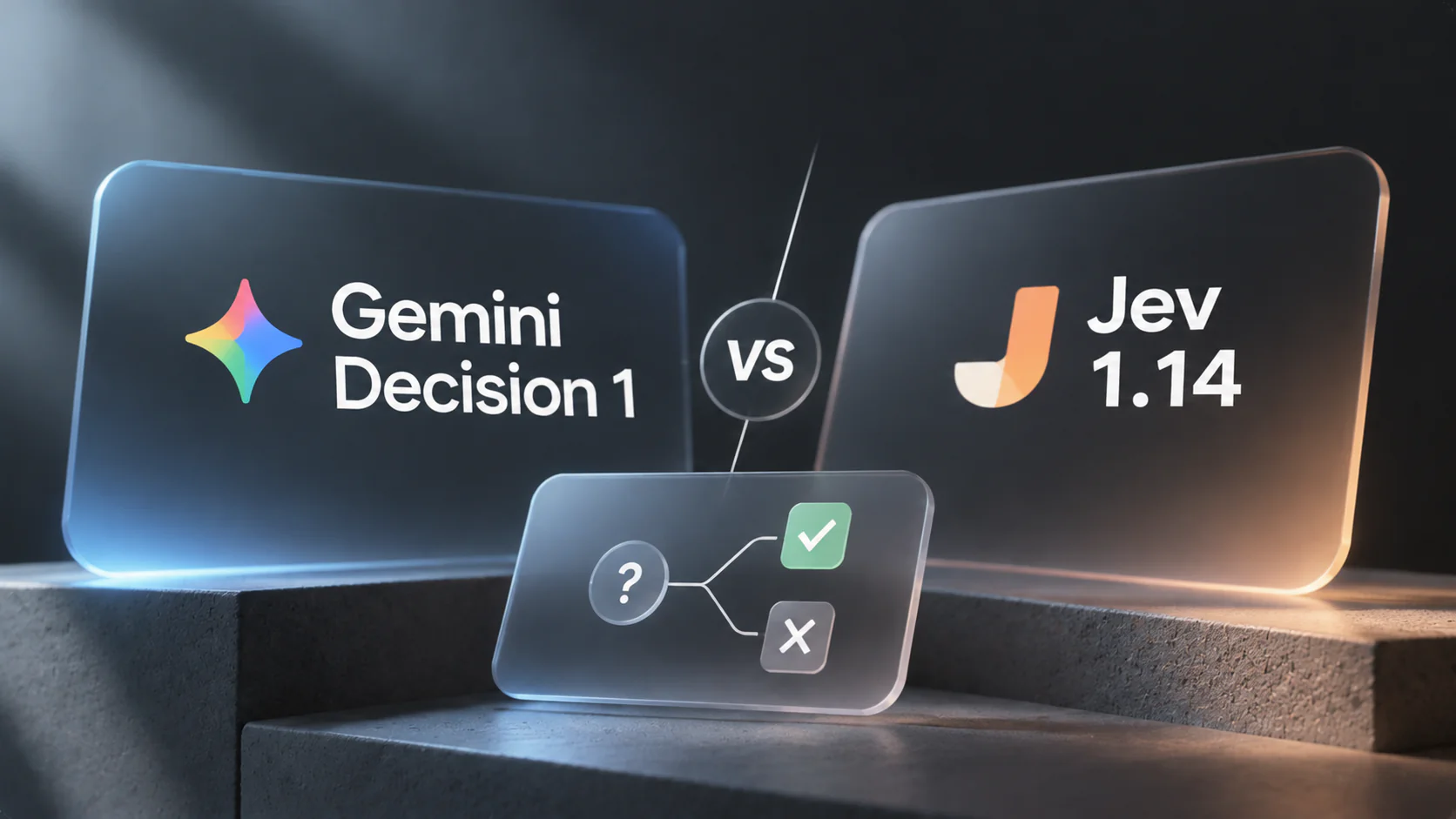
Two months ago, TypeSafe's Jev was close to the only serious decision model on the market. Now Google has entered with Gemini Decision 1, and the two are close enough on paper that choosing between them is a real question. Both skip text generation, both answer typed questions with probabilities, and both charge only for input tokens.
They are not the same, though. Gemini Decision 1 reads audio, video and PDFs and is backed by Google's infrastructure. Jev 1.14 is cheaper per token, faster in independent tests, and ranks slightly ahead on the leading independent decision benchmark. On Google's own benchmarks, Gemini leads most tests.
This comparison puts the official specs side by side, separates vendor claims from independent results, and adds our own head-to-head test of 40 marketing and e-commerce decisions, run twice on each model, plus tests of batching, answer consistency and option order. Specs are checked against each company's documentation as of November 14, 2026.
The Short Answer
- Choose Gemini Decision 1 if you need audio, video or PDF inputs, the most stable answers between runs, a confidence score on every answer, or a free tier to start. It was also more accurate on the harder cases in our test.
- Choose Jev 1.14 if cost at scale and raw speed matter most, especially when you ask many questions about the same input. It was about 2.7 times cheaper when we batched 12 questions in one call.
- For simple, clear-cut decisions, both were perfect in our test, and cost per single call was almost identical.
Gemini Decision 1 vs Jev at a Glance
Facts below come from Google's Decisions API documentation and TypeSafe's model documentation.
- Maker and launch: Gemini Decision 1 by Google, launched November 11, 2026. Jev by TypeSafe AI, first launched in September 2026, with version 1.14 released October 14, 2026.
- Price: Gemini Decision 1 costs $0.10 per million input tokens. Jev costs $0.042. Both charge nothing for output, and Jev charges images at the same per-token rate.
- Context: Gemini Decision 1 has a 262,144 token window. Jev defaults to 64,000 tokens per request and 32,000 per question, and can be raised to 262,000 with an opt-in header that TypeSafe says is “slower and less accurate.”
- Inputs: Gemini Decision 1 accepts text, images, audio, video and PDFs. Jev accepts text and JSON, plus PNG and JPEG images through an opt-in header that TypeSafe labels not yet production-ready. Jev does not accept audio or video.
- Question types: both use the same names, noul (yes or no), choice and score. Jev 1.14 adds box, which returns the location of an object in an image, also experimental.
- Limits: Gemini allows up to 1,000 questions per request, 2 to 255 choice options and 2 to 255 score levels. Jev has no fixed question limit as long as the request fits the context, up to 255 choice options and 2 to 10 score levels.
- Confidence: Gemini returns a confidence value on every answer. Jev returns confidence for choice and score but not for yes or no questions, where you work with the probability directly.
- Free tier: Gemini Decision 1 has a free tier in Google AI Studio. We found no free tier for Jev.
- Access: Gemini through the Gemini Developer API (v1beta), Google AI Studio and OpenRouter, with Google Cloud support “coming soon.” Jev through TypeSafe's API and SDKs, and OpenRouter.
What Do the Benchmarks Say?
Google's benchmarks (vendor-reported)
At launch, Google compared Gemini Decision 1 with Jev 1.14 on seven shared tests, as reported by VentureBeat and DataCamp. Gemini led five: JevBench (92.2% vs 90.0%), Amazon ESCI product search (58.7 vs 56.7), New Yorker caption matching (79.7% vs 72.0%), PubMedQA (79.8% vs 78.2%) and Global-MMLU-Lite (86.0% vs 85.0%). Jev led two, both agent tasks: Mind2Web Multimodal (86.8% vs 86.2%) and When2Call tool decisions (82.0% vs 79.9%).
Google also reported a calibration error of 0.025 for Gemini against 0.049 for Jev, meaning Gemini's probabilities matched real accuracy more closely in Google's tests. On cost, Google's own figures put Jev cheaper across the shared tests: $0.68 against $0.88.
Independent benchmark: Artificial Analysis
The Artificial Analysis Decision Index scores decision models on six evaluations and rewards well-calibrated probabilities, not just correct picks. According to VentureBeat's report of the results, the two models are almost tied:
- Jev 1.14: score 66.23, 92 milliseconds per task, $156 per million tasks.
- Gemini Decision 1: score 65.98, 211 milliseconds per task, $345 per million tasks.
- On individual tests, Jev led on When2Call (80.8% vs 75.2%) and on the AA-Paperclip document test (35.5% vs 33%).
Neither model tops that index. Nace AI's Drex Max v1.1 scored 72.62, a reminder that this market is moving quickly. The takeaway from the benchmarks is that quality is close, Gemini leads on Google's tests, Jev edges ahead on the independent index, and Jev is faster and cheaper per task.
Our Head-to-Head Test
To see how the two behave on everyday business decisions, we ran our own test on November 14, 2026, calling both models through OpenRouter from Vietnam. OpenRouter served Gemini Decision 1 (version dated November 11, 2026) and Jev 1.14 (version dated October 14, 2026). The test had four parts.
1. Accuracy on 40 labeled decisions
We wrote 40 questions with known answers, 23 straightforward and 17 deliberately hard, with 8 in Vietnamese. They covered support ticket routing, lead qualification, prompt injection detection and review sentiment. Hard cases included a refund question that mentions a return, a tracking link that shows an error page, a freelancer asking for a partnership, a review that hides an instruction aimed at an AI assistant, and mixed reviews.
- Overall: Gemini Decision 1 got 38 of 40 right, Jev 35 of 40.
- Easy cases: both 23 of 23.
- Hard cases: Gemini 15 of 17, Jev 12 of 17.
- By task: both got 9 of 9 prompt injection cases right, including the hidden instruction in a review, 11 of 12 on routing and 8 of 9 on sentiment. The gap was lead qualification: Gemini 10 of 10, Jev 7 of 10.
The details matter. Jev's three lead mistakes all came with probabilities between 0.44 and 0.62, close to a coin flip. TypeSafe's documentation suggests treating yes or no answers between 0.3 and 0.7 as uncertain, and with that rule all three would have gone to a person instead of being decided wrongly. Gemini's two mistakes, a broken tracking link it sent to shipping instead of technical support and a mixed review, came with confidence of 0.75 and 0.50. Both models missed the same mixed review.
2. Consistency between runs
We ran all 40 questions twice. Gemini Decision 1 returned identical results both times, down to the decimal. Jev's probabilities moved slightly between runs, by up to 0.09, but no answer changed. For audit trails and testing, Gemini's repeatability is an advantage.
3. Option order
TypeSafe's documentation notes that Jev “leans toward the option that comes first” in choice questions. We reran the 12 routing questions with the options in reverse order. Neither model changed any answer. Jev's probabilities shifted by an average of 0.015, while Gemini's did not move at all, because Google sorts options alphabetically before evaluating them.
4. Speed, cost and batching
- Speed: median response time was 784 milliseconds for Gemini and 624 milliseconds for Jev, measured end to end from Vietnam through OpenRouter. Both are slower than the vendors' own figures because of distance and the extra network hop, but Jev was consistently faster, matching the independent benchmark.
- Cost per single call: almost the same, about $0.0000133 for Gemini and $0.0000141 for Jev. Jev is cheaper per token, but it counted about 335 input tokens per call where Gemini counted 133 for the same text.
- Batching: we asked 12 questions about one product review in a single call. Both got all 9 checkable answers right. The batched call cost $0.000079 on Gemini and $0.000030 on Jev, so Jev was about 2.7 times cheaper. Compared with 12 separate calls, batching was about 3 times cheaper on Gemini and 6.5 times cheaper on Jev, and took under 0.7 seconds instead of 8 to 11 seconds in total.
The batching result is the most practical lesson in this comparison: whichever model you choose, ask all your questions about an input in one request. And if you ask many questions per input, Jev's pricing advantage becomes real.
Our test is small, ran the accuracy questions twice and the other parts once, and used text only, so treat it as a practical check rather than a benchmark. The test questions were written by us, which may favor how we phrase business decisions.
Which Should You Use for Each Job?
Choose Gemini Decision 1 for
- Checking audio, video or PDF content, such as call recordings, product videos, invoices or contracts.
- Decisions where wrong answers are costly and you want the most accurate model on harder cases, based on our test and Google's benchmarks.
- Workflows that need repeatable results for audits, testing or compliance.
- Teams that want a free tier to prototype, or already work in the Google ecosystem.
Choose Jev 1.14 for
- High volume text decisions where cost matters, especially with many questions per input.
- Speed-sensitive uses such as agent routing and tool choice, where independent tests show it is faster and slightly better.
- Teams comfortable using uncertainty thresholds, sending answers between 0.3 and 0.7 to a person.
What Are the Limits of Each?
- Both: a valid answer format does not guarantee a correct answer, and choice questions always spread probability across your options even when none fits. Add a catch-all option or a yes or no check.
- Gemini Decision 1: it is a v1beta API without caching or batch discounts, not yet on Google Cloud, and independent hands-on testing by MindStudio found weaker results on audio emotion and spotting AI-generated video.
- Jev 1.14: TypeSafe lists known weak spots, including literal reading, counting, numbers and dates, and very long irrelevant input. Image and box features are experimental, and long context is slower and less accurate.
How to Choose for Your Own Workflow
- Collect 50 to 100 real examples of one decision your team makes, with the correct answers.
- Run them through both models with the same question wording, and include your hardest cases.
- Compare accuracy, the share of answers in the uncertain zone, and cost per call with your real input sizes.
- Batch all questions about the same input into one request.
- Set a confidence or probability threshold below which cases go to a person, then monitor results after launch.
Decision models are one of the most practical ways to cut AI costs in 2026, because they replace expensive language model calls for the many small yes, no and pick-one decisions inside a business. If you want help choosing and setting up the right one for your workflows, our AI training program can help. Contact us to plan a session.
Frequently asked questions
Is Gemini Decision 1 better than Jev?
It depends on the job. Gemini Decision 1 leads most of Google's benchmarks and was more accurate on hard cases in our test (38 of 40 vs 35 of 40). Jev 1.14 scores slightly higher on the independent Artificial Analysis Decision Index, is faster, and is cheaper per token. On simple decisions, both were perfect in our test.
Which is cheaper, Gemini Decision 1 or Jev?
Jev costs $0.042 per million input tokens against $0.10 for Gemini Decision 1, and both charge nothing for output. In our test, single calls cost about the same because Jev counted more tokens for the same text, but with 12 questions batched in one call Jev was about 2.7 times cheaper.
Which is faster?
Jev. The Artificial Analysis Decision Index reports 92 milliseconds per task for Jev against 211 for Gemini Decision 1, and in our test from Vietnam the median was 624 milliseconds for Jev and 784 for Gemini.
Can Jev read images, audio or PDFs?
Jev 1.14 can read PNG and JPEG images through an opt-in setting that TypeSafe says is not yet production-ready. It does not accept audio or video. Gemini Decision 1 accepts text, images, audio, video and PDFs.
Do Gemini Decision 1 and Jev use the same question types?
Yes. Both use noul for yes or no, choice for picking an option and score for rating on a scale. Jev 1.14 also has an experimental box type that returns the location of an object in an image.
Do they give the same answer every time?
In our test, Gemini Decision 1 returned identical results on two runs. Jev's probabilities changed slightly, by up to 0.09, but none of its answers changed.
Need help with this?
Growthtrait can help you put this into practice. Let's talk about your goals.
Contact us