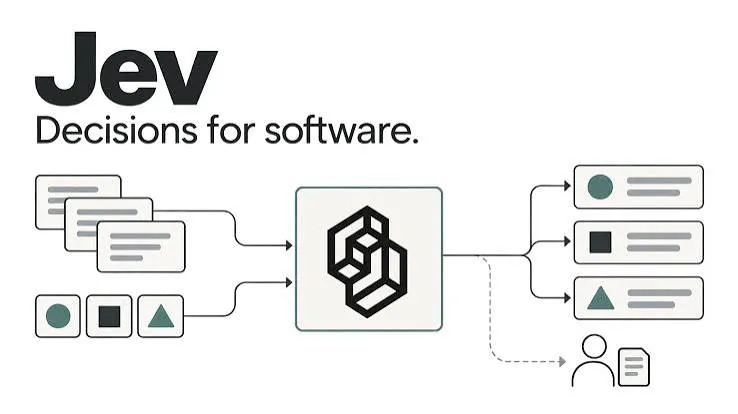


Every large language model released in the last few years has done the same basic thing: read text, then write text back. On September 15, 2026, a San Francisco startup called TypeSafe AI released a model that refuses to do that. It is called Jev, and it does not generate a single word.
Jev is TypeSafe's first release, built by a team led by Diogo Almeida, who spent roughly four years at OpenAI working on the reinforcement learning from human feedback behind InstructGPT, ChatGPT, and GPT-4 before leaving in 2024. The launch came with a $40 million seed round led by DCVC and a $200 million valuation, and the Hacker News thread announcing it hit 1,655 points and 456 comments within a day, a striking reaction for a closed-source model from a startup that had been in stealth.
This post covers what Jev actually is, how a decision model differs from a language model like ChatGPT or Claude, the technical ideas behind it, its speed and cost claims, where it fits next to browser use agents, and why developers reacted with as much skepticism as excitement.
What Is Jev?
Jev is TypeSafe AI's first model in a category the company calls System One models, a name Almeida based on Daniel Kahneman's Thinking, Fast and Slow: fast, intuitive System 1 thinking, rather than the slow, deliberate reasoning most large language models are built around. As Almeida put it at launch, models have been superhuman at chat for years, so where is all the automation.
Instead of accepting a prompt and writing a text response, Jev accepts state data plus a typed question and returns a typed value with a calibrated probability attached. Its Wikipedia entry describes three primitive question types it can answer: Choice, picking from a fixed set of options; Score, rating something against ordered levels; and Noul, a yes or no evaluation. There is no free-form output. Whatever Jev returns has to fit a schema decided in advance.
That makes Jev what the industry has started calling a decision model: something built to make a structured decision inside a piece of software, not to hold a conversation with a person. It is a genuinely different job than what ChatGPT, Claude, or Gemini are built for, closer to a very capable classifier than a chatbot.
How Is a Decision Model Different From a Language Model?
A language model like GPT-6 Astra or Claude Fable 5.1 generates open ended text token by token, autoregressively, meaning each piece of output depends on everything generated before it. That is what lets a chat model write a paragraph, hold a conversation, or explain its reasoning.
- Jev is non-autoregressive: it produces its typed output in a single parallel pass rather than token by token, which TypeSafe says is most of where its speed comes from.
- It trains with Reinforcement Learning for Calibrated Decisions, or RLCD, optimizing its probabilities against real outcomes rather than against human preference rankings, which is how RLHF trains a chat model.
- It trains exclusively on synthetic data, and TypeSafe has not published a full technical paper describing the architecture.
- Because its answer space is constrained to a predefined schema, Jev cannot return a malformed or out of schema answer, which is the basis for TypeSafe's claim that it cannot hallucinate.
A decision model, in other words, trades away everything that makes a chat model good at open ended writing in exchange for speed, cost, and a guarantee about the shape of its output.
What Can Jev Actually Do?
TypeSafe positions Jev for tasks that need a fast, structured decision rather than an explanation:
- Classification and routing, such as sorting a support ticket or a piece of content into a category.
- Large scale extraction, pulling structured fields out of unstructured text or state data.
- Scoring and rating, ranking something against ordered levels rather than a single label.
- Verification and guardrailing, checking the output of another AI system before it ships.
- Decision branching inside agentic workflows, and real time applications that need a response in well under a second.
TypeSafe demonstrated the model with an unusual example: having Jev play Doom at roughly 10 decisions per second, about $7 an hour, by reading a text description of the game's state rather than seeing pixels on screen. Critics noted that detail made the demo less impressive than the framing suggested, since a simple rules based bot reading the same state description could plausibly play just as well.
How Fast and Cheap Is Jev, According to TypeSafe?
TypeSafe's headline numbers are aggressive. The company reports response times of 70 to 500 milliseconds, and says Jev runs 40 to 200 times faster than frontier LLMs on comparable tasks, with a peak claim of 193.6 times on internal workflows. On cost, input tokens are priced at $0.042 per million with output free, which TypeSafe frames as 40 to 400 times cheaper than frontier models, peaking at a claimed 444.6 times. The company has acknowledged these are best case figures rather than typical results across every workload.
Why Are Developers Skeptical of Jev's Claims?
The Hacker News thread announcing Jev was originally titled New frontier model 40 to 400x cheaper and 20 to 200x faster, and was renamed within an hour, a small but telling sign of how the framing landed with developers actually reading the details.
- The benchmarks are TypeSafe's own. Rather than publishing to public leaderboards, the company grades its workflow evaluations by agreement with the averaged answers of GPT-6 Astra and Claude Fable 5.1, not against independently verified ground truth.
- Cannot hallucinate is a narrow claim. Jev cannot return an answer outside the schema it was given, but it can still confidently return the wrong answer within that schema. One widely quoted Hacker News comment put it plainly: it cannot emit an invalid type, but it can still emit a wrong valid value.
- The speed comparison is not fully apples to apples. A generative model producing type names, schema, and explanatory prose is doing more work per response than a model that only emits one constrained decision, which makes a raw multiple like 200 times faster harder to interpret on its own.
None of this means Jev does not work. It means the number worth trusting is the one you measure on your own task, not the one in the launch post.
How Does Jev Relate to Browser Use Agents?
Jev's launch landed in the same stretch of weeks as ChatGPT Atlas shutting down and GPT-6 Astra positioning itself as a computer use model, both about agents that browse and act rather than only answer. It is tempting to lump decision models and browser use agents together as the same trend, but they solve different parts of the same problem.
A browser use agent is built to navigate a live interface across many steps: reading a page, clicking, filling a form, deciding what to do next. A decision model like Jev is built for the single decision inside one of those steps, not for driving the browser itself. In practice, an agent that needs to decide whether a page shows an add to cart button or a sold out message does not need a full chat model to make that call. That is a natural place for something like Jev to sit underneath a larger browser use workflow, handling the fast, narrow decisions while a heavier model handles planning and any open ended output.
Seen this way, decision models and browser use agents are complementary categories rather than competitors, and a real AI pipeline is likely to end up using both: a language model for generation and planning, a browser use agent for acting on an interface, and a decision model for the high volume classification and verification calls in between.
Should You Actually Use Jev?
Jev is a reasonable fit for high volume, narrow, well defined decisions where latency and cost matter and where a fixed answer schema genuinely captures the task: classification, routing, scoring, and guardrailing existing AI output. It is not a fit for anything that needs open ended writing, nuanced explanation, or a conversation, since that is not what it was built to produce.
Because Jev is 12 days into early access with a waitlist and no independent benchmarks yet published, the sensible approach is to pilot it narrowly on a task where you can check the ground truth yourself, rather than replacing an existing model in production on the strength of the vendor's own numbers.
Where This Leaves Things
Jev is a genuine engineering idea, not just a marketing angle: a model that trades open ended generation for a hard guarantee on output shape is useful for a real class of problems that chat models are overkill for. The numbers in TypeSafe's launch post are the company's own, though, and the category is new enough that no independent lab has verified them yet. Expect other labs to ship narrower, decision focused models of their own before long, since the gap Jev is pointing at, cheap structured decisions at scale, is real.
If you are building AI content pipelines and trying to work out which of these pieces, a language model, a browser use agent, or a decision model, actually belongs where, our AI content marketing service is built to help you make that call. Contact us and we will look at your workflow.
Frequently asked questions
What is Jev AI?
Jev is a model released by TypeSafe AI on September 15, 2026 that returns typed decisions with calibrated probabilities instead of generating text. TypeSafe calls it a System One model, built for fast, structured decisions like classification and routing rather than conversation.
Is Jev a language model?
No. Jev does not generate free form text at all. It answers a typed question, such as a choice, a score, or a yes or no evaluation, and returns a value that must fit a predefined schema, which is why the industry describes it as a decision model rather than a language model.
What is a decision model?
A decision model is an AI model built to produce a structured, typed decision inside software rather than to hold a conversation or write open ended text. Jev is the first widely covered example, and the category is positioned as a faster, cheaper complement to language models for narrow, well defined tasks.
Is Jev faster than ChatGPT?
TypeSafe claims Jev responds in 70 to 500 milliseconds and runs 40 to 200 times faster than frontier language models on comparable tasks. Those figures come from TypeSafe's own benchmarks rather than independent testing, and developers have noted the comparison is not fully apples to apples since Jev produces far less output per response.
Can Jev browse the web?
No. Jev is a decision model, not a browser use agent. It is built to make a single structured decision from state data it is given, not to navigate a live interface across multiple steps the way a computer use model like GPT-6 Astra or a browser agent like the former ChatGPT Atlas is designed to do.
Need help with this?
Growthtrait can help you put this into practice. Let's talk about your goals.
Contact us